
The Silent Portfolio Killer: When "Free" Crypto Becomes a Financial Nightmare
I will never forget the panic I felt during the massive market crash a few years ago. I had been happily earning daily staking rewards for months, thinking I was building a completely safe future for my family. But when my accountant told me I owed thousands of dollars in taxes on tokens that were now basically worthless, my stomach dropped. That expensive, painful mistake forced me to completely change how I handle my digital money today.
You sit there, staring at the screen, heart pounding in your chest. You did everything the financial gurus suggested. You bought solid digital assets, locked them up in a secure network, and started earning passive staking rewards. It felt like printing free money while you slept.
But nobody warned you about the hidden catch.
For thousands of ordinary investors, this is not just a scary thought. It is a harsh reality. People often stake their tokens during a massive market boom. They receive daily or weekly rewards, watching their token balance grow with excitement.
Then, the market suddenly drops. The value of their entire portfolio shrinks drastically. But when tax season arrives, they discover something terrifying. The government expects them to pay taxes based on the high value of those tokens on the exact day they received them, not the crashed price of today.
Now, they owe more in taxes than their entire remaining portfolio is even worth.
This creates an intense level of emotional burnout. What was supposed to be a stress-free way to build wealth suddenly becomes a massive financial trap. The anxiety of facing an audit, the confusion of navigating complicated tax laws, and the fear of losing your hard-earned savings can completely destroy your peace of mind.
You are not alone if you feel completely overwhelmed by this. The rules around digital assets are incredibly confusing, and the system often feels designed to punish the little guy.
But you do not have to live in fear of your own investments. By understanding exactly how these rules work right now, you can take back control of your financial future and protect your portfolio from silent destruction.
Decoding the Reality of Staking: What You Actually Need to Know
To protect yourself, we must first break down how tax agencies actually view your digital earnings. The biggest mistake you can make is assuming the blockchain operates entirely outside the traditional financial system.
The moment your rewards hit your wallet, the clock starts ticking.
Let us walk through exactly what happens behind the scenes and how you can safely manage this process without losing your mind.
The Dangerous "Hold and Ignore" Myth
There is a very common rumor spreading across social media forums. Many beginner investors believe that you only owe taxes when you finally sell your digital assets for traditional fiat cash, like US Dollars or Euros.
This is dangerously incorrect when it comes to staking.
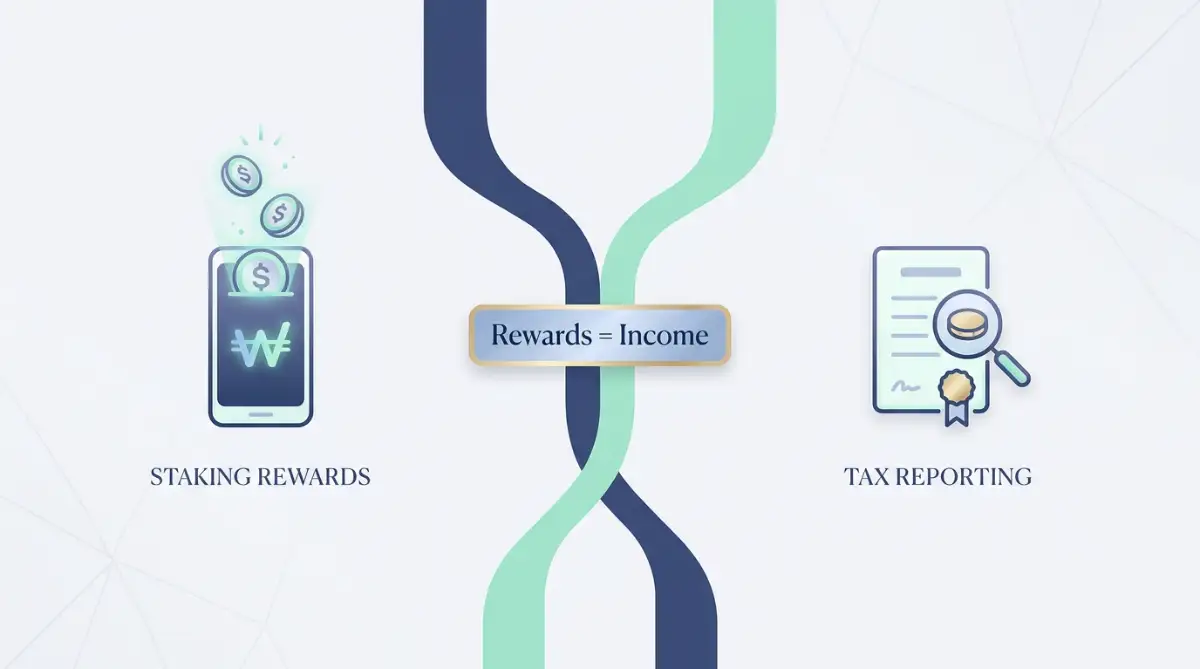
Tax authorities around the world generally treat staking rewards just like earning a salary at a normal job. Think about how a traditional paycheck works. When your employer hands you a check, you owe taxes on that income immediately for that specific year.
It does not matter if you leave that money sitting in your bank account forever. You still have to report it.
Staking works exactly the same way. When the blockchain network deposits new tokens into your digital wallet, a Taxable Income Event occurs instantly.
Understanding the "Fair Market Value" Trap
Here is where the math gets incredibly tricky and where most people get caught off guard.
When you receive a staking reward, you must calculate its Fair Market Value (FMV). This means you need to know exactly how much that specific token was worth in fiat currency on the exact day and time it entered your wallet.
Let us look at a real-life scenario to make this perfectly clear.
Imagine you are staking a popular digital asset. On a Tuesday in the middle of a massive market rally, you receive 10 tokens as a reward. On that specific Tuesday, each token is trading at $100.
In the eyes of the tax agency, you just earned $1,000 of ordinary income. You must report that $1,000 on your tax return.
Now, imagine the market crashes a few months later. Those same tokens are now only worth $10 each. Your total reward value is now just $100.
However, the tax agency does not care about the crash. They still expect you to pay taxes on the original $1,000 value you received on that Tuesday. This is the exact trap that bankrupts unprepared investors during a bear market.
Pro Tip: Stop Relying on Mental Math
Expert Insight: Never try to track these daily rewards manually in a notebook or a basic spreadsheet. When you stake on certain networks, you might receive micro-rewards multiple times a day. Trying to find the exact price history for every single minute of the year is impossible for a human. Start using automated portfolio tracking software that specifically syncs with your public wallet addresses.
If you are still trying to track your daily crypto rewards with a messy spreadsheet, watch this quick video to see how modern tracking software can easily automate this entire headache for you.
The Double Taxation Illusion: Capital Gains
Now that we understand the initial income problem, we need to talk about the second phase of the tax journey.
Many people feel like they are being taxed twice on the exact same money. While it feels unfair, understanding the mechanics will help you plan your exits safely.
When you eventually decide to sell your staked tokens, trade them for another digital asset, or use them to buy goods, you trigger a Capital Gains Event.
To calculate your capital gains, you need a baseline number. This is called your Cost Basis.
Remember those 10 tokens you received when they were worth $100 each? That $1,000 original value becomes your cost basis. It is your starting line.
If the market recovers and you later sell those 10 tokens when they are worth $150 each, your total sale is $1,500.
You do not pay taxes on the full $1,500 again. You only pay capital gains taxes on the profit. In this case, you subtract your $1,000 cost basis from the $1,500 sale price. You only owe capital gains tax on that $500 of new profit.
What Happens When You Sell at a Loss?
Let us reverse the scenario. What happens if you sell those tokens during a market crash?
If your cost basis was $1,000, but you panic and sell the tokens when they are only worth $200 total, you have experienced a Capital Loss of $800.
This sounds terrible, but it actually provides a hidden silver lining for smart investors.
In many regions, you can use these capital losses to offset your other capital gains. If you made a huge profit trading a different digital asset, you can apply this $800 loss to reduce your overall tax bill for the year. This strategy is known as Tax-Loss Harvesting.
Actionable Steps to Protect Your Wealth Today
Now that the complex mechanics are out of the way, how do you actually survive this system without spending all your free time stressing over spreadsheets?
You need a bulletproof defensive strategy.
Step 1: Separate Your Staking Wallets
One of the best things you can do right now is create dedicated wallets purely for your staking activities.
Do not mix your active day-trading funds with your long-term staking bags. When everything is mixed together in one single account, calculating your cost basis becomes an absolute nightmare.
By keeping your earning assets isolated, you create a clean, easy-to-read paper trail. If you ever get audited, handing over the data from an isolated wallet is clean, simple, and transparent.
Step 2: Export Your Data Monthly
Do not wait until the final week of tax season to gather your documents. Blockchain explorers and decentralized platforms can sometimes undergo maintenance or change their data structures.
Make it a habit to export your transaction history as a CSV file on the first day of every month.
Save these files in a secure, encrypted folder on your computer. Having hard copies of your transaction hashes, timestamps, and received amounts is the ultimate insurance policy against platform failures.
Step 3: Keep a Liquid Fiat Reserve
This is the most important survival rule for anyone earning digital rewards.
Because you owe taxes based on the value of the token at the time of receipt, you should immediately set aside a percentage of your earnings to cover that future tax bill.
If you receive $1,000 worth of tokens, consider selling 20% to 30% of them immediately for stable coins or fiat currency.
Store those funds in a separate savings account. If the market crashes later in the year, you will already have the exact amount of cash needed to pay the government. You will sleep peacefully while others panic.
I used to reinvest every single penny of my staking rewards right back into the market because I wanted to grow my portfolio faster. Now, the moment I earn any tokens, I immediately swap thirty percent of them into regular dollars and move it straight to my bank account. It might feel slow at first, but knowing my tax bill is already paid before tax season even starts is the best feeling in the world.
The Complex World of Liquid Staking Tokens
We also need to address a modern evolution in the digital economy that is confusing even seasoned accountants.
When you use decentralized protocols to stake your assets, you often receive a receipt token in return. For example, if you deposit your main tokens, the protocol might give you a "staked" version of that token to hold in your wallet.
The tax treatment of these liquid receipt tokens is currently a massive gray area.
Some aggressive tax agencies view the moment you swap your original token for the receipt token as a fully taxable crypto-to-crypto trade. They treat it as if you sold your original asset entirely.
Other jurisdictions view it merely as a deposit, where no taxable event occurs until you trade the receipt token back for your original assets.
Myth vs Reality: Decentralized Finance (DeFi) Anonymity
The Myth: "I am using a decentralized protocol without completing any identity verification (KYC). The government has no way of knowing what I am earning."
The Reality: The blockchain is a permanent, public ledger. Every single transaction you make is visible to anyone in the world.
Tax agencies are heavily investing in advanced blockchain forensic software. If you have ever interacted with a centralized exchange to cash out your funds, your anonymous decentralized wallet is now permanently linked to your real-world identity.
Trying to hide your staking rewards is a high-risk game that you will eventually lose. Honesty and proactive tracking are your only true shields.
Organizing Your Digital Paper Trail
To maintain completely clean records, you must categorize your transactions accurately.
Not all incoming tokens are staking rewards. Sometimes you receive an airdrop. Sometimes you receive a refund for a failed transaction. Sometimes you are just moving your own funds from a hardware device to a mobile app.
If you use automated tracking software, do not just blindly trust its automatic tags. Go through your incoming transactions manually once a week.
Ensure that your staking rewards are explicitly labeled as "Income" or "Staking Reward". Ensure that your personal wallet transfers are labeled as "Internal Transfer" so they do not accidentally get counted as taxable income.
Taking just fifteen minutes a week to categorize your data will save you dozens of hours, and potentially thousands of dollars in accounting fees, when tax season finally arrives.
By treating your digital investments with the same level of respect and organization as a traditional business, you eliminate the fear of the unknown. You transform the stressful chaos of crypto taxes into a simple, manageable routine.
Mastering the Financial Chessboard: Pro Strategies for Sustained Wealth
Once you understand the basic mechanics of how digital rewards are taxed, you can start playing offense. Surviving tax season is great, but keeping more of your hard-earned money legally is even better.
I want to share some advanced accounting strategies that professional investors use behind closed doors. These methods completely change how you manage your portfolio.
The most powerful tool in your defense kit is understanding Specific Identification Accounting. When you finally decide to sell your staked tokens, you actually have a choice.
You get to choose exactly which tokens you are selling. This might sound strange, so let us use a simple real-life analogy to make it clear.
Imagine you own a grocery store, and you buy apples at different times of the month. Some apples cost you $1, and others cost you $3. When a customer buys an apple from you, you can record whether you sold the $1 apple or the $3 apple. The digital asset market works exactly the same way.
Many beginners use the default First-In, First-Out (FIFO) method. This means they assume the first token they ever bought or earned is the first one they sell. This often leads to massive tax bills, because early tokens were usually acquired at much lower prices.
Instead, smart investors often use the Highest-In, First-Out (HIFO) method.
By telling your accounting software to sell your most expensive tokens first, you drastically reduce your immediate profit on paper. Smaller profits mean a much smaller capital gains tax bill. You keep more money in your pocket today.
Before applying these advanced accounting methods, it is always wise to review the official guidelines on digital asset reporting to ensure your chosen method aligns with local regulations.
The Secret Math of Network Gas Fees
There is another brilliant strategy that most everyday investors completely ignore. Every time you interact with a blockchain, you have to pay a network fee, often called a "gas fee."
When you click the button to claim your daily or weekly staking rewards, a small network fee is deducted from your wallet. Over twelve months of active staking, these tiny fees can add up to hundreds or even thousands of dollars.
Here is the secret: those transaction fees are not just thrown-away money.
In many jurisdictions, the fees you pay to acquire or sell an asset can be used to adjust your original cost basis. If you pay a $10 network fee to sell a token, that $10 reduces your taxable profit.
By carefully tracking every single network fee associated with claiming and moving your rewards, you can legally shrink your taxable income. It requires attention to detail, but the financial savings are absolutely worth the effort.
Scenario: The Power of Strategic Timing
Let us look at a practical scenario to see how timing changes everything.
Suppose you are earning steady rewards on a network, but you know the overall market is extremely unpredictable right now. Managing these emotional swings is tough, which is why understanding the true nature of market risks is so helpful for long-term survival.
If you claim your rewards every single day during a massive price spike, you are locking in very high taxable income events.
However, some decentralized protocols allow you to let your rewards accumulate in a smart contract without actually depositing them into your personal wallet. They just sit there, waiting for you to hit the "claim" button.
If your specific local tax laws define a taxable event as the moment the tokens hit your actual wallet, you have a huge advantage.
You can simply wait for the market to dip. When the price of the token drops significantly, you finally hit the claim button. Your rewards enter your wallet at a much lower fair market value, creating a much smaller income tax burden.

The Silent Wealth Destroyers: Habits That Invite Audits
Even with the best strategies, human nature often gets in the way. People get lazy, they get greedy, or they simply forget how permanent the blockchain really is.
I have seen countless investors completely destroy their financial lives by making a few very specific, easily avoidable mistakes. Let us walk through the most dangerous behavioral traps in the digital economy.
The Trap of Endless Chain-Hopping
One of the biggest mistakes you can make is constantly moving your assets across different blockchain networks just to chase a slightly higher staking percentage.
You might bridge your tokens from a layer-one network over to a new layer-two scaling solution because they promise an extra 2% return. This sounds like smart investing, but it is an accounting nightmare.
Every time you move assets across a bridge, you often receive a wrapped version of your original token. Many tax authorities view wrapping a token as a taxable crypto-to-crypto trade.
You think you are just moving your own money around. The government thinks you are aggressively day-trading.
If you do not track these bridging events perfectly, your accounting software will break. It will lose the original cost basis of your tokens, assume you have zero history, and calculate your entire portfolio as pure profit.
"What If I Just Use Privacy Protocols?"
This is a question I hear all the time. An investor will get tired of tracking numbers, so they decide to route their staking rewards through a privacy mixer or an anonymous decentralized exchange.
They believe they can simply erase their financial footprint. This is a catastrophic error in judgment.
Federal agencies possess incredibly sophisticated blockchain forensic tools. They study federal frameworks regulating virtual currencies and work directly with chain-analysis companies to trace seemingly hidden funds.
If you get audited and an investigator sees your funds suddenly disappear into a privacy protocol and reappear later, they will assume the absolute worst. You will instantly trigger a massive red flag for tax evasion.
The penalties for intentional evasion are brutal. The compounding interest on unpaid taxes can quickly exceed the value of your entire digital portfolio.
Instead of building wealth for your family, you might find yourself desperately searching for ways to pay off massive government fines. Some people even end up needing to figure out how to secure fast unsecured bank loans for immediate cash just to keep the authorities away.
Do not play games with the public ledger. Complete transparency is your best defense.
Ignoring the Dust in Your Wallet
Another seemingly harmless mistake is ignoring micro-transactions.
Sometimes, protocols distribute tiny fractions of a token to your wallet. We call this "crypto dust." Because the value is so small—often less than a few pennies—most people never bother to report it.
The problem is not the dollar amount. The problem is the missing data.
If you decide to sell that dust three years from now when the token price has exploded, your tax software will have no idea where those tokens came from. Missing acquisition data creates gaps in your reporting history, which is the exact thing that triggers automated audit algorithms.
Treat every single incoming transaction with maximum respect, no matter how small it seems today.
Your Morning Action Plan: Protecting Your Portfolio Today
We have covered a massive amount of technical and emotional ground. You might feel a little overwhelmed right now, and that is a completely normal reaction to this complex system.
But I want you to take a deep breath. You are now far more educated than the vast majority of digital investors operating in the market today.
You no longer have to operate in fear. You have the knowledge to build a secure, legally compliant financial fortress around your staking rewards.
Think of this process like planning for a massive real estate purchase. Just as you would carefully research how to purchase your dream house with zero money down by getting your paperwork in perfect order, you must apply that same discipline to your digital assets.
To help you get started immediately, I have created a simple, actionable checklist for you to follow tomorrow morning. Do not wait for tax season to arrive. Start building your defense right now.
Your Proactive Defense Checklist:
- Audit Your Wallets: Sit down with a cup of coffee and list every single public wallet address where you are currently staking assets.
- Sync Your Data: Connect those specific wallet addresses to a reputable, read-only crypto tax software platform. Let the software pull your complete transaction history.
- Label the Unknowns: Spend twenty minutes filtering your transactions to find anything labeled "uncategorized." Manually tag your staking rewards as income.
- Establish a Fiat Reserve: Look at your estimated current tax liability for the year. Move that exact amount of cash into a high-yield traditional savings account so you are completely protected against future market crashes.
By taking these small, deliberate steps, you completely remove the anxiety of investing. You take the power away from unpredictable markets and confusing regulations, putting it right back into your own hands.
You are building a digital portfolio to create a life of freedom and peace of mind. Treat your accounting with the respect it deserves, and that freedom will be yours to keep forever.
I know how boring and scary crypto taxes can feel, but taking control of my numbers completely removed my everyday anxiety. You do not have to be a math genius to fix this today; just pick one simple tracking software and connect your main wallet. Take that first small step right now, and you will finally be able to enjoy your investments without constantly looking over your shoulder.
Disclaimer: The content provided in this article is purely for informational and educational purposes. It does not constitute professional tax, legal, or financial advice. Cryptocurrency markets are highly volatile, and tax regulations regarding digital assets change frequently. Always consult a certified public accountant (CPA) or a qualified tax attorney in your specific jurisdiction before making any financial or reporting decisions.