
The Heavy Weight of Endless Research

I remember staring at my glowing laptop screen at 3 AM, completely exhausted but unable to sleep. My desk was buried under a massive pile of notebooks, colorful sticky notes, and printed market reports. I was trying to map out the absolute perfect launch strategy for my new online business.

For three straight months, I did almost nothing but read articles, listen to podcasts, and build complex financial spreadsheets. The sad truth is, I had not spoken to a single potential customer. I had not launched even a basic landing page to test my ideas.

I was absolutely terrified of making a mistake, so I hid behind endless research. I convinced myself that I was being productive. In reality, I was just running in circles and hiding from the actual work.

When you are trapped in the planning phase, your mind plays exhausting tricks on you. You constantly feel busy, but you are not actually making any real progress. Every time you try to take a real step forward, a little voice in your head asks for more data.

You start thinking you need to read just one more book or take one more online course before you are truly ready. This constant need for information creates a heavy, suffocating anxiety in your chest. You wake up thinking about your idea, and you go to sleep stressing over details that do not even matter yet.

Every single day, thousands of smart people deal with this exact same mental block. They watch other people launch businesses with messy, imperfect ideas. They see competitors making money and gaining followers, while their own perfect idea collects dust on a hard drive.

It is incredibly frustrating to know you have the talent and the drive, yet you cannot seem to press the launch button. This mental block slowly destroys your confidence. The excitement you originally felt for your project slowly turns into dread and extreme exhaustion. You become a prisoner of your own high standards.
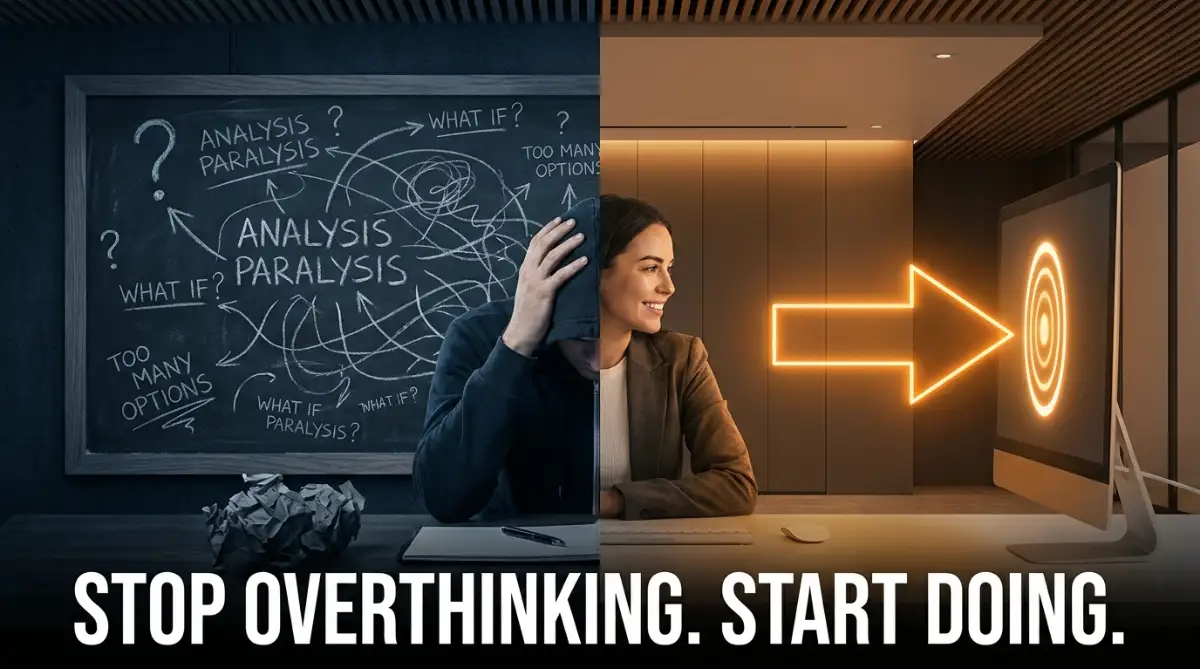
Shifting Your Mindset from Thinker to Doer

To break free from this painful loop, we need to completely change how we view the planning phase. Taking action is not about abandoning strategy entirely. It is about recognizing when planning stops being helpful and starts becoming a form of self-sabotage.

When we hold onto our ideas too tightly, we prevent them from growing. Business is not a test you can study for perfectly. It is a live experiment. You have to mix the ingredients together and see what happens in the real world.

Below, we are going to explore practical, deeply actionable steps to get your ideas out of your head and into the real market.

Recognizing the Illusion of Productive Procrastination

The hardest part about overthinking is that it often feels like real work. You might spend five hours designing a logo, picking brand colors, or organizing your task management software. At the end of the day, you feel tired and accomplished.

However, none of those activities actually move the needle for your business. This is what we call productive procrastination. You are doing tasks that are related to your business, but you are avoiding the core tasks that carry real risk.

Buying a domain name is easy because no one can reject you. Calling a potential client is terrifying because they might say no. Our brains naturally want to protect us from rejection and failure.

Because of this, we subconsciously choose the safe, planning-based tasks over the scary, action-based tasks. The first step to overcoming this is radical honesty. You have to look at your daily to-do list and ask yourself if you are actually moving forward, or just keeping yourself busy.

Applying the 70% Decision Framework

One of the most effective ways to stop overthinking is to change your criteria for making a decision. Most perfectionists want to be 100% sure about an outcome before they take a step. In the real world, having perfect information is entirely impossible.

By the time you gather 100% of the data, the market has already moved on. Your competitors have already launched, learned from their mistakes, and improved their products. This is why you need to adopt the 70% rule.

The concept is simple. Once you have about 70% of the information you need, you must force yourself to make a decision and act. Yes, you will still have blind spots. Yes, there is a chance you might make a wrong turn.

But correcting a small mistake while moving forward is always faster than standing completely still. The momentum you gain from making quick decisions will teach you far more than any book or article ever could.

My personal journey completely changed when I stopped trying to predict every possible failure. I started realizing that I could fix problems as they appeared, rather than trying to prevent them all in advance.

I remember wasting three whole weeks trying to pick the perfect payment gateway for my first website. I read hundreds of reviews and stressed over tiny fee differences. Finally, I realized I did not even have a single paying customer yet! I just picked a popular option in five minutes and moved on. The lesson was clear: stop optimizing for problems you do not even have.

Time-Boxing Your Information Intake

Information is necessary, but consuming too much of it will paralyze you. We live in an era where thousands of experts are giving conflicting advice online. One person tells you to focus entirely on social media, while another says you must master email marketing.

If you try to listen to everyone, you will end up doing nothing. To fix this, you need to set strict boundaries on your research phase. We call this time-boxing.

Instead of saying, "I will research my market until I understand it," give yourself a hard deadline. Tell yourself, "I have exactly three days to research my competitors. After Friday at 5 PM, I am no longer allowed to read about this topic. I must start building."

When you give yourself a strict time limit, your brain automatically filters out the useless noise. You focus only on the most important details because you know time is running out.

If you find yourself stuck in a loop of endless note-taking, this breakdown will change how you approach new projects forever.

Defining Your Minimum Viable Test (MVT)

Most entrepreneurs are familiar with the concept of a Minimum Viable Product. But when you are stuck in analysis paralysis, even a minimum product can feel too overwhelming to build.

Instead of trying to launch a whole product, you need to focus on a Minimum Viable Test. An MVT is the smallest, fastest, and cheapest way to test your core assumption. You are not trying to build a business yet. You are just trying to see if people actually care about your idea.

For example, if you want to start a meal delivery service, you do not need to lease a commercial kitchen, hire staff, or build a complex mobile app. That is the planning trap talking.

Your Minimum Viable Test could be printing out 50 flyers, putting them in your neighbors' mailboxes, and seeing if anyone calls your phone number. If ten people call, you know you have a real business idea. You can cook the meals in your own kitchen for the first week.

If nobody calls, you just saved yourself months of wasted effort and thousands of dollars. Break your big, scary business idea down into a tiny, harmless test.

The Difference Between Preparation and Fear

Let us look closely at how our minds try to trick us. It is very helpful to see the stark difference between actual planning and toxic overthinking.

BehaviorProductive PlanningToxic Overthinking (Paralysis)
Focus AreaSetting specific, clear goals for the week.Worrying about what might happen six months from now.
InformationGathering just enough data to take the next step.Reading the same advice multiple times without acting.
OutcomeResults in a physical action or a published piece of work.Results in more lists, more notes, and intense fatigue.
MindsetAccepting that early mistakes are part of the process.Believing that any mistake will destroy the entire business.

Understanding this difference allows you to catch yourself in the act. When you open another browser tab to read yet another review, you can stop and ask yourself: "Is this productive planning, or is this fear?"

Embracing the Messy Middle of Business

Think about learning how to ride a bicycle. You can read ten different books on the physics of balance. You can study the mechanics of pedals and gears. You can watch hundreds of slow-motion videos of professional cyclists.

But the very moment you sit on that seat, all that theory goes completely out the window. You have to feel the balance for yourself. You have to wobble, scrape your knee, get back up, and try again.

Starting a business works the exact same way. You cannot learn how to run a business on paper. You have to get into the arena and get your hands dirty.

The early days of any successful startup are completely chaotic. Your first website will look amateurish. Your first sales pitch will probably be awkward and messy. Your first few customers might point out obvious flaws in your service.

This is not a sign of failure. This is the exact process of building something great. The most successful founders are not the ones who plan perfectly. They are the ones who are willing to look foolish in the beginning.

Breaking Down Big Goals into Micro-Actions

Another major reason we fall into analysis paralysis is that our goals are simply too big. If your to-do list says, "Launch the company," your brain will naturally panic. The task is too large, too vague, and too intimidating.

When the brain gets overwhelmed, it shuts down and demands more research as a delay tactic. To trick your brain into taking action, you need to slice your massive goals into tiny, almost ridiculous micro-actions.

Instead of "Launch the company," your first task should be "Write three sentences for the website homepage." That is a task so small that you cannot possibly fail.

Once you write those three sentences, you will feel a tiny burst of momentum. That small win gives you the confidence to write the next three sentences. Suddenly, without even realizing it, you are actually doing the work instead of just planning it.

Momentum is the ultimate cure for overthinking. Once you start moving, it becomes much easier to keep moving. An object in motion stays in motion. You just have to force yourself to take that very first, tiny step.

Stop Comparing Your Beginning to Someone Else's Middle

One of the biggest triggers for analysis paralysis is constantly watching what everyone else is doing. We scroll through social media and see successful founders sharing their massive wins.

We see their polished branding, their flawless websites, and their massive customer bases. Then, we look at our own messy notes and feel completely inadequate.

We try to plan harder to make sure our launch looks just as professional as theirs. What we forget is that we are comparing our messy Chapter 1 to their highly polished Chapter 20.

When those successful founders started, their branding was likely terrible. Their systems were broken. They figured it out by launching and adapting over time.

If you try to launch at their current level of quality, you will never launch at all. You have to give yourself permission to be a beginner. It is okay if things are duct-taped together in the early days. The goal is to get moving, not to look perfect for an imaginary audience.

The Power of a Mental Brain Dump

Sometimes, analysis paralysis happens simply because our working memory is overloaded. You have too many ideas, strategies, and fears bouncing around inside your head all at once.

When your brain is full, it cannot process any new decisions. The best way to clear this mental traffic jam is to do a complete brain dump.

Take a blank piece of paper and write down absolutely everything you are thinking about regarding your business. Write down your wild ideas, your stupid ideas, and your deepest fears. Do not edit yourself. Just get the thoughts out of your head and onto the paper.

Once the thoughts are written down, they lose their power over you. You can look at them objectively. You will quickly realize that most of the things you are worrying about are not actually urgent.

You can cross off the fears that do not matter and circle the one single action you need to take today. A clear mind is an action-oriented mind.

Valuing Customer Feedback Over Personal Assumptions

The most dangerous thing about staying in the planning phase too long is that you start believing your own assumptions are absolute facts. You assume you know what the customer wants. You assume you know how much they will pay.

In reality, your assumptions are just guesses. The longer you spend planning, the more attached you become to these guesses.

The only way to find the real truth is to interact with real human beings. If you put a rough, unfinished idea in front of a real customer, they will tell you exactly what is wrong with it.

Customer feedback is worth a thousand hours of private planning. They might tell you that they do not care about the fancy feature you spent three weeks mapping out. Instead, they might ask for a simple solution you never even considered.

When you prioritize customer conversations over private research, your business naturally moves in the right direction. You stop guessing and start building based on actual human behavior.

Mastering the Art of Continuous Execution

Now that we understand why our brains trap us in endless research, we need a system to stay out of that trap. You cannot just rely on temporary motivation to keep moving forward. Motivation fades away very quickly when things get difficult.

To maintain real momentum, you have to build a daily execution habit. You need to train your mind to prefer messy action over comfortable planning. This completely changes how you approach your daily tasks.

When you try to force your brain out of a deep state of anxiety, it often backfires and makes you feel worse. The process is remarkably similar to how to train an anxious dog without breaking their spirit. You have to use gentle consistency and small rewards rather than harsh pressure.

Start by changing your physical workspace environment. If your desk is covered in heavy business books and complex planners, clear them away. Keep only a single notepad and a pen in front of you.

Your physical environment heavily influences your mental clarity. A messy, complicated desk encourages messy, complicated overthinking. A clean desk silently commands you to do the actual work.

The Power of the 48-Hour Execution Window

One of the most effective strategies I use is the 48-hour rule. Whenever you have a new idea for your business, you must test a small version of it within 48 hours. If you cannot test it within two days, the idea is simply too big for your current stage.

Let us say you want to offer a brand-new consulting service. Do not spend three weeks building a pricing structure and a fancy presentation. Instead, send a direct message to three ideal clients today and ask if they would pay for it.

If they ignore you, you just saved yourself three weeks of useless planning. If they say yes, you now have real clients waiting, which forces you to build the service immediately. The pressure of an actual waiting customer is the ultimate cure for overthinking.

Protecting Your Mind from Decision Fatigue

Founders often get stuck simply because they have made too many small choices in one day. This is a recognized psychological condition known as decision fatigue, where the quality of your choices drops after a long session of thinking.

If you spend all morning deciding on brand colors, font sizes, and email templates, your brain will be exhausted by noon. When it is time to make a real choice, like calling a supplier, you will avoid it. You will tell yourself you need to "do more research" just to delay the scary task.

To beat this, you must automate the unimportant details. Pick a basic website template and refuse to change it for six months. Wear simple clothes, eat the same breakfast, and remove tiny daily choices from your routine. Save your precious mental energy for actions that actually generate revenue.

You do not need a massive bank loan to test your early ideas. Much like figuring out how to purchase your dream house with zero money down, starting a business is entirely about leveraging your creativity instead of just throwing cash at the problem.

Adopting the 'Draft One' Mindset

Writers have a secret weapon that entrepreneurs should steal immediately. They never try to write a perfect book on the first try. They write something called a "vomit draft," where they just throw all their messy thoughts onto the paper.

They know that the first draft will be terrible, and they are completely fine with that. As a founder, your first product, your first email, and your first marketing campaign should be treated exactly like a rough draft.

Stop trying to launch a finished masterpiece. Launch Draft One. Then, let the market tell you how to edit it into Draft Two. Building a culture of execution within yourself means accepting that early versions will always look a bit ugly.

The Silent Traps That Keep Founders Stuck

Even when you start taking action, your brain will try to pull you back into the comfort zone of planning. It is incredibly important to recognize these silent traps before they completely derail your progress. The most dangerous mistakes often look like productive work on the surface.

The Trap of Building in a Cave

Many first-time founders fall deeply in love with their own ideas. They become paranoid that someone is going to steal their brilliant concept. Because of this fear, they refuse to share their plans with anyone until the product is entirely finished.

This is the biggest mistake you can possibly make. Ideas are completely worthless without execution. Hiding your idea means you are starving it of the oxygen it needs to surviveβ€”which is real customer feedback.

When you finally launch your secret project after a year of silent planning, nobody will care. You will have built something based entirely on your own private assumptions, not on what the market actually wants to buy.

Ignoring Legal Realities for Marketing Fantasies

Spending weeks perfecting an Instagram aesthetic while forgetting to properly register your business entity is a form of analysis paralysis. You are hiding in the fun tasks to avoid the intimidating paperwork. Face the boring tasks first, get them out of the way, and then you can play with the fun marketing details.

Over-Insuring Against Imaginary Failures

Some founders try to protect their new business from every possible future problem. They spend months creating backup plans for scenarios that have a zero percent chance of happening this early on.

This behavior is completely irrational. It is very much like trying to figure out how to buy the best travel insurance for pre-existing conditions when you have not even applied for a passport yet. You are stressing over step ten when you have not even completed step one.

When you worry about server crashes before you have a single website visitor, you are just stalling. Deal with today's problems today. Let tomorrow's problems wait until they actually arrive.

The Comfort of Endless Learning

Buying another online course feels amazing. Reading another biography of a famous billionaire makes you feel inspired. But consuming endless educational content is a very sneaky form of procrastination.

You convince yourself that you are actively working on your business. In reality, you are just sitting on the couch being a passive consumer. According to the lean startup methodology, real learning only happens when you test a hypothesis in the real world.

Stop buying courses. Stop listening to three different business podcasts every morning. Put down the books and start applying the five percent of knowledge you already have.

Leaving the safety of a regular paycheck is terrifying for any new founder. You might constantly worry about things like the truth about employer-sponsored insurance is your family truly safe while trying to build your own safety net. Use that fear as fuel to execute faster, rather than using it as an excuse to keep planning.

Your Action Plan for the Next 24 Hours

We have talked extensively about the psychology of taking action. Now, it is time to put these concepts to the ultimate test. Closing this article and going back to your research notes is not an option.

You need a practical, immediate plan to break the cycle of overthinking today. Follow this exact sequence over the next 24 hours to force yourself into motion.

Step 1: Declare a Research Ban

Starting right now, you are on a strict 48-hour research ban. You are not allowed to open Google to check competitor pricing. You are not allowed to read any more articles about marketing strategies.

Your brain has enough data to make the very next move. Trust your current level of knowledge. Close all the tabs on your browser that are related to planning and strategy.

Step 2: Identify the Smallest Moveable Piece

Look at your massive project and find the absolute smallest task that involves the outside world. Do not pick a task that you can do alone in your room. Pick something that forces you to interact with a potential customer or the market.

This could be publishing a single post on LinkedIn asking a question to your target audience. It could be sending a simple text message to an old colleague to pitch your service. Make the task so tiny that doing it takes less than five minutes.

Step 3: Embrace the Power of Public Commitment

Fear thrives in silence. If you only make promises to yourself, it is incredibly easy to break them without any consequences. To guarantee that you take action, you must make a public commitment.

Tell a trusted friend or post on your personal social media exactly what you are going to launch by the end of the week. Studies on the value of early market entry show that founders who create external pressure launch significantly faster. When other people are expecting you to deliver, your desire to avoid public embarrassment will completely override your desire to over-plan.

Step 4: Celebrate the Ugly Wins

When you finally put your imperfect idea out into the world, it might feel a bit embarrassing. The landing page might have a typo, or the sales pitch might sound a little clumsy. Instead of beating yourself up, you must celebrate this moment.

You did something that 99 percent of people are too scared to do. You stepped out of the safety of the planning phase and into the reality of the arena. Every ugly win is a massive step toward a refined, profitable business.

I know exactly how terrifying it feels to put a half-finished idea out into the open market for people to judge. My biggest personal and financial breakthroughs only happened when I stopped hiding behind my notebooks and finally pressed the publish button. You have done more than enough reading for today; now it is your time to go build something absolutely amazing.

Common Questions About Escaping the Planning Trap

How do I know if my startup idea is actually ready to test?

Your idea is ready to test the exact moment you can explain the core benefit in one simple sentence. You do not need a logo, a website, or a registered company to ask people if they want your solution. If you have a clear offer, you are ready to start talking to people today.

Is it totally normal to feel completely paralyzed before launching?

Yes, it is entirely normal and happens to almost every successful entrepreneur. Your brain is simply trying to protect you from the emotional pain of potential rejection. Acknowledging that this fear is just a biological response helps you push right through it.

Should I spend time writing a traditional 50-page business plan?

Unless you are actively walking into a bank today to ask for a million-dollar loan, a massive business plan is a complete waste of time. Most traditional business plans become completely useless the moment you get your first real customer. Stick to a one-page lean canvas that outlines your basic offer and target audience.

How do I mentally handle negative feedback on my first rough prototype?

You have to train yourself to view negative feedback as free, highly valuable consulting. When someone tells you why your product is bad, they are actually handing you the exact blueprint to make it profitable. Do not take it personally; just use the data to fix the product immediately.

What is the absolute fastest way to stop overthinking a business name?

Give yourself exactly one hour to write down twenty names on a piece of paper. Pick the one that sounds the least annoying and instantly buy the domain name. Remember that massive companies like Google and Yahoo have silly names; the product quality is what actually builds the brand.

Disclaimer: The information provided in this article is for educational and informational purposes only and should not be construed as professional financial, legal, or business advice. Starting a business involves inherent risks, and individual results may vary based on market conditions, personal effort, and external factors. Always consult with a certified professional or legal advisor before making significant financial decisions or registering a business entity. We are not responsible for any losses or damages resulting from the application of the strategies discussed in this content.