
The Heavy Cost of Building in the Dark
I still remember the exact moment I realized my very first business was a complete disaster. I had locked myself in my bedroom for six straight months, building what I thought was the absolute perfect digital product. I poured all my mental energy, late-night coffee, and hidden hopes into making it look absolutely flawless.
When launch day finally arrived, I pushed the publish button and waited for the magic to happen. Absolutely nothing happened, and my email inbox remained totally empty. I had spent half a year of my life building a product that nobody actually wanted to use.
That crushing realization hit me like a ton of heavy bricks. It completely destroyed my confidence and made me question if I was even meant to be an entrepreneur at all. My mental peace was completely gone, replaced by a heavy cloud of endless self-doubt.
Millions of people walk around every single day carrying this exact same fear in their chests. You have a brilliant idea bouncing around in your head, but you are absolutely terrified to start. You look at your empty bank account and assume you need thousands of dollars just to test the waters.
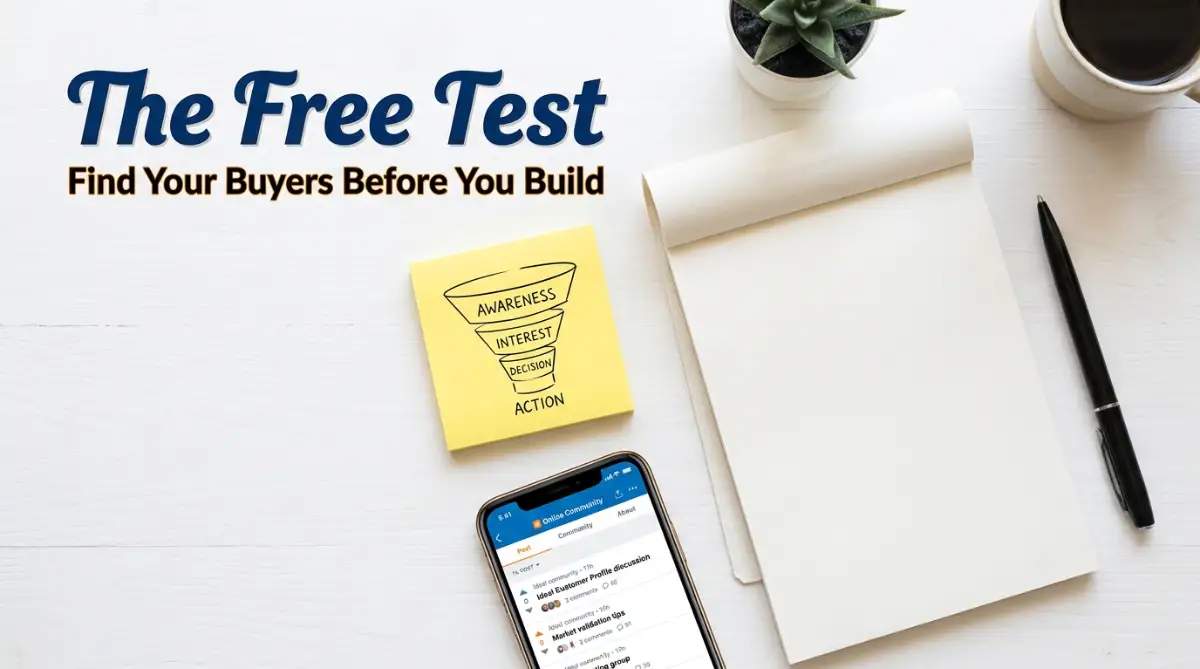
This constant hesitation slowly eats away at your daily happiness and motivation. You sit at your regular desk job, staring blankly at the computer screen, wondering what could happen if you just took the leap. But the deep fear of wasting your hard-earned savings keeps you frozen completely in place.
It is incredibly exhausting to live in this state of "what if" while watching other people build their dreams online. The hidden stress spills over into your family life, making you highly irritable and distracted during dinner conversations. You desperately want a way out, but the financial risk feels way too heavy to carry on your shoulders.
Most normal people eventually give up on their dreams because they think money is the only way to find out if an idea is good. They accept a life of regret simply because nobody taught them how to test the market safely.
But what if I told you that testing your biggest idea does not require a massive bank loan or a rich investor? You can actually find out exactly what people want to buy without spending a single penny of your own money. Let me show you the exact, zero-risk blueprint I now use to test every new concept completely for free.
The Zero-Dollar Strategy to Test Market Demand
To build a highly successful business, you have to completely change the way you view product creation. You do not build a product and then go looking for customers to buy it. You find the customers first, figure out their biggest problems, and then build exactly what they ask for.
This completely flips the traditional business model upside down. It removes all the massive financial risk and puts you in total control of your own success. Let us break down the exact steps you can take today to test your idea for free.
Overcoming the "Mom Test" Trap
The very first thing most new entrepreneurs do is pitch their big idea to their family and close friends. This is actually the most dangerous mistake you can make when starting out. Your friends and family love you, which means they will instinctively lie to protect your feelings.
When you ask your mother if she likes your new app idea, she will always say it is brilliant. She is not giving you actual business data; she is just giving you emotional support. This false validation gives you fake confidence to spend money on something no one will actually buy.
To get real data, you must talk to complete strangers who owe you absolutely nothing. Strangers will give you the harsh, honest truth about your concept. If a total stranger is willing to give you their time or email address, you know you are actually onto something meaningful.
Strategy 1: The Digital Eavesdropping Method
You do not need to spend thousands of dollars on expensive market research agencies to understand your buyers. Your ideal customers are already hanging out online, loudly complaining about the exact problems you want to solve. You just need to know exactly where to look and how to listen.
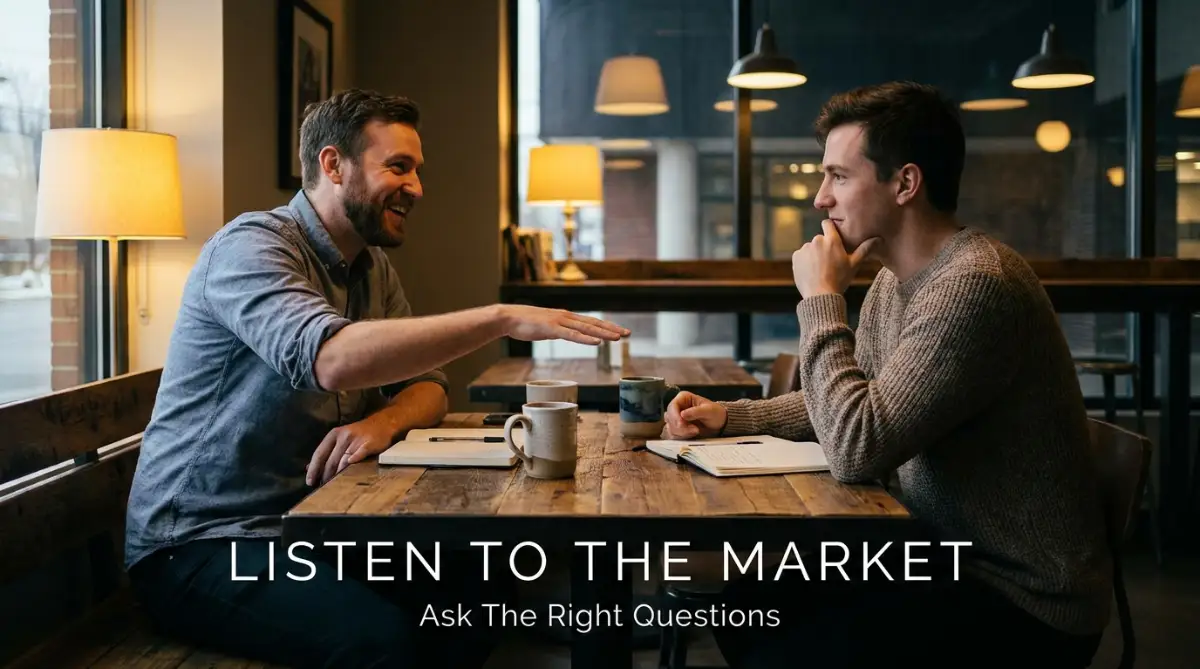
Think of the internet as a massive, crowded coffee shop. If you sit quietly in the corner, you can hear exactly what people are frustrated about. Platforms like Reddit, specialized Facebook groups, and Quora are absolute goldmines for this free research.
Go to a specific Reddit community related to your business idea. Instead of posting your idea, use the search bar to look for words like "I hate," "struggling with," or "cannot find." You will instantly see hundreds of highly detailed posts from people explaining their daily pain points.
Pro Tip from My Experience: I used to think my ideas were completely original and perfect right out of my head. I quickly realized that reading through angry customer reviews on Amazon for similar products gave me way better insights than my own brainstorming; fixing what people already hated became my ultimate shortcut to success.
If you want to start a meal prep service, look for people complaining about wasting food or having no time to cook. Write down the exact phrases and words they use in their complaints. You will use their exact words later to sell your solution back to them.
Strategy 2: The Free "Fake Door" Landing Page
Once you know exactly what problem you are solving, you need to see if people will actually click a button to solve it. You do not need to build the actual product to test this interest. You only need to build the "door" to the product and see how many people try to open it.
This is highly known in the startup world as a Fake Door test. You create a very simple, one-page website that perfectly describes your upcoming product or service. You explain the massive benefits and tell the visitor exactly how it will change their life.
At the very bottom of the page, you place a button that says "Get Early Access" or "Join the Waitlist." You can build this entire page completely for free using tools like Google Sites, Carrd, or the free tier of Mailchimp. You do not need to pay for web hosting or a fancy domain name just yet.
Watch This Quick Guide to Setting Up a Free Landing Page in Minutes:
When someone clicks that button and types in their email address, they are voting with their time. They are proving to you that the problem is highly annoying enough for them to take physical action. If you share this free link in relevant communities and nobody signs up, you just saved yourself months of wasted effort.
Strategy 3: The Manual Concierge Approach
Many people think they need to hire a software developer to build a complicated automated system. Automation is highly expensive, but doing things manually is completely free. Before you build a massive app or a complicated service, you should try to do the entire process by hand.
Imagine you want to start an automated personal shopping service for busy professionals. Instead of spending ten thousand dollars on a custom algorithm, just message five busy people in your network. Offer to pick out their clothes for the week completely by yourself using text messages.
You become the algorithm behind the scenes. This is exactly how massive companies like Zappos originally started selling shoes online. The founder literally walked to local shoe stores, took pictures of shoes, posted them online, and bought them manually when someone ordered.
Doing things manually costs absolutely zero dollars, but it gives you highly direct contact with your customer. You will quickly discover the small, hidden problems in your business model that no software could ever predict.
Comparing Testing Methods: Free vs Expensive
Reading the Hidden Buying Signals
Getting an email address is a great start, but it is not the ultimate proof of a winning business. You have to learn how to measure the actual intent of your potential buyers. People are highly protective of their money, but they are also very protective of their personal time.
If someone is willing to get on a fifteen-minute video call to discuss their problem with you, that is a massive buying signal. It means the problem is hurting them enough that they are willing to sacrifice their free time to find a solution.
During these free calls, do not pitch your product right away. Just ask them how they currently try to solve the problem and how much money they spend trying to fix it. If they are already spending money on bad solutions, they will absolutely pay for your good solution.
The Difference Between Vitamins and Painkillers
When you are testing your idea, you need to figure out which category your product falls into. In the business world, every single product is either a vitamin or a highly effective painkiller.
Vitamins are nice to have. They improve your life slightly, but if you forget to take them for a week, you do not really care. People are highly hesitant to spend money on vitamins when the economy gets tough.
Painkillers, on the other hand, solve an immediate, agonizing problem. If you have a massive headache, you will gladly pay whatever it takes to get rid of the pain instantly. When you are validating your idea, you must ensure you are selling a painkiller.
If people look at your free landing page and say, "That looks kind of cool," you have built a vitamin. If they urgently ask you, "When can I give you my money for this?", you have successfully found a painkiller.
Using Existing Platforms for Free Traffic
One of the biggest excuses people make is saying they have zero audience to test their idea on. You do not need your own massive audience when you can freely borrow someone else's. Existing platforms already have millions of highly active users waiting to be engaged.
If you want to test a digital template, a coaching service, or a unique physical craft, use platforms like Medium, Twitter, or local classifieds. Write a highly helpful, free article solving a small part of your customer's problem.
At the bottom of that helpful article, drop the link to your free "Fake Door" landing page. If your free advice was highly valuable, the right people will naturally click through to see what else you have to offer.
This content-driven approach requires zero financial investment. It only requires your brain, your keyboard, and a deep willingness to help people solve their daily frustrations.
Escaping the Perfectionism Trap
The main reason we want to spend money on fancy logos and expensive websites is because we are hiding behind perfectionism. We think if the business looks highly professional, people will not judge us if the idea actually fails.
Perfectionism is just fear in a really good disguise. Your first test does not need to look pretty; it just needs to clearly communicate your offer. An ugly landing page that solves a desperate problem will always outperform a beautiful website that solves nothing.
Give yourself permission to be messy and scrappy in the beginning. The goal is not to look like a massive Fortune 500 company on day one. The absolute only goal is to find one single person who says, "Yes, I need this right now."
Once you get that very first highly genuine signal of interest, the fear completely melts away. You finally have the hard proof you need to step out of the shadows and start building something truly amazing.
Breaking Past the Surface: Advanced Strategies for Market Proof
Getting your very first email subscriber from a free landing page is a truly amazing feeling. It proves that you are no longer just guessing; you actually have a real person interested in your idea. But one single email address is not enough to build a reliable, long-term business.
To create a highly successful venture, you need to turn that initial spark of interest into a predictable system. You have to figure out how to gather deep, psychological data from your potential buyers without spending any money on fancy tracking tools. This requires thinking entirely outside the box.
Most beginners stop testing the moment someone says, "That sounds like a great idea." Professional entrepreneurs know that a compliment is totally worthless unless it comes with a commitment. Let us dive into some incredibly powerful, advanced methods to truly understand what your market wants.
The Magic of the "Shadow Test"
You do not need to buy expensive heatmap software to understand how people behave on your free landing page. You can easily set up a "shadow test" using completely free tools provided by tech giants. By connecting a free Google Analytics account to your simple waitlist page, you unlock a massive amount of hidden behavioral data.
When you look at this free data, pay very close attention to the time people spend on your page. If someone clicks your link, stays for two seconds, and leaves, your main headline is completely failing. If they stay for three minutes but never click the subscribe button, your offer is simply not strong enough.
According to behavioral research published by the MIT Sloan Management Review, understanding user drop-off points is the single fastest way to improve a digital product. You are practically reading your customer's mind just by watching how they scroll.
Mining the "Three-Star" Reviews
Your biggest competitors have already spent millions of dollars educating the market and gathering customers. You can legally steal all of their expensive customer research by simply reading their online reviews. However, the real secret is completely ignoring the five-star and one-star ratings.
Five-star reviews are usually blind praise, and one-star reviews are often just angry people venting about shipping delays. The absolute goldmine of business data lives entirely inside the three-star reviews. These customers liked the product enough to buy it, but they were deeply disappointed by one specific missing feature.
When you read hundreds of three-star reviews, you will see a highly repetitive pattern of frustration. Your entire business idea should simply be fixing that one specific frustration. You are taking an already proven concept and making it perfectly tailored for an unhappy group of buyers.
The Art of the "Friction" Pitch
Normally, we want to make it as easy as possible for someone to sign up for our services. But when you are testing for true market demand, adding a little bit of difficulty is actually a brilliant strategy. If someone is willing to jump over a hurdle to reach you, their buying intent is incredibly high.
Instead of just asking for an email address, ask them to fill out a short, three-question form about their specific problem. This acts as a natural filter for window shoppers. The people who take the time to type out full sentences are the exact people who will eventually pull out their credit cards.
Do's and Don'ts of Cold Customer Outreach
Reaching out to strangers on the internet can feel very intimidating at first. Here is a quick guide to keeping your outreach highly effective and completely free:
- Do focus entirely on their specific problem, not your brilliant solution.
- Do not send massive, robotic text blocks; keep your messages short and conversational.
- Do ask open-ended questions like, "What is the hardest part about your daily routine?"
- Do not ever drop a link to your website in the very first message.
When you approach people with genuine curiosity instead of a sales pitch, they are incredibly eager to share their struggles. You can find more practical lifestyle and business strategies over at our main hub on infozonee.com.
The Silent Traps That Destroy New Founders
Even when you are testing an idea completely for free, it is shockingly easy to fall into emotional traps. Building a business is a highly vulnerable process, and our brains constantly try to protect our egos from the sting of rejection. This natural defense mechanism often leads us down completely the wrong path.
I have watched incredibly smart people waste years of their lives building things nobody wanted because they ignored the obvious warning signs. Understanding these common mistakes is just as important as understanding the hidden legal traps that can destroy your new startup overnight. Let us explore the massive pitfalls you must avoid at all costs.
Falling in Love with the Solution, Not the Problem
This is the absolute biggest killer of new business ideas. You wake up with a brilliant idea for a highly complex smartphone app, and you instantly fall in love with how cool it sounds. You spend weeks designing the logo and picking out brand colors before you even know if the problem is real.
You are essentially building a shiny, expensive key and running around the city trying to find a door that it fits into. A true entrepreneur does the exact opposite. They find a massive, locked door that is frustrating thousands of people, and then they design a very simple key to open it.
If your target audience tells you they do not want an app, and they just want a simple email newsletter, you have to listen to them. You must completely detach your personal ego from the final format of the product. Your only job is to solve the pain in the easiest way possible.
The Danger of the "Fake Promise"
When you are interviewing potential customers, they will often try to be highly polite to you. They will say things like, "Wow, that sounds really interesting, I would totally buy that when it launches." This is the most dangerous sentence in the entire business world.
A future promise to buy something is completely worthless data. It gives you a false sense of security, much like discovering the truth about employer-sponsored insurance; you think you are safe until you actually try to use it in the real world.
To test if they are actually telling the truth, you have to ask for a micro-commitment right then and there. Ask them to pre-pay at a massive discount, or ask them to introduce you to their boss to discuss the software. If they suddenly start making excuses, you instantly know they were just being polite.
Experts at the Stanford Graduate School of Business highly emphasize that you should strictly measure what people do, not what they say. Actions always reveal true market demand, while words are just comfortable lies.
Hiding Your Idea Out of Fear
Many first-time founders are absolutely terrified that someone is going to steal their million-dollar idea. Because of this fear, they refuse to talk about their concept in public forums. They force their friends to sign ridiculous non-disclosure agreements before sharing a basic thought.
Here is the harsh reality: your raw idea is actually worth absolutely nothing. There are thousands of people who have had the exact same thought you did while taking a shower this morning. The true value of a business comes entirely from how well you execute the daily operations.
If you hide your idea from the world, you block yourself from getting the free feedback you desperately need to survive. A massive corporation is not going to steal your untested concept because they are too busy dealing with their own internal problems. Share your idea loudly and proudly to attract the exact people who need it.
Over-Surveying Without Any True Intent
Sending out a free Google Form to a massive Facebook group feels like you are making real business progress. You get fifty responses back, and you feel incredibly productive analyzing the pie charts. But surveys are completely cold, heartless data points.
A multiple-choice survey cannot capture the heavy sigh a customer makes when talking about their daily frustrations. It completely misses the subtle changes in their voice that reveal deep, emotional pain. If you only rely on cold data, you are completely missing the human element of sales.
Research from the Harvard Business Review clearly shows that face-to-face or voice conversations yield massively higher insights than any digital survey ever could. Use surveys just to gather email addresses, but use live video calls to gather the actual human truth.
The "Sunk Cost" Justification
Sometimes, your free tests will clearly show that your idea is a complete and total failure. Nobody clicks the link, nobody wants to talk on the phone, and the market is completely silent. Instead of accepting defeat, many beginners try to force the idea to work simply because they already spent three weeks thinking about it.
This is known as the sunk cost fallacy. You keep pushing a massive boulder up a steep hill because you refuse to admit you picked the wrong mountain. Recognizing failure early is actually a massive victory because it saves you from wasting the next five years of your life.
Common Questions About Zero-Budget Idea Testing
Can I really validate a physical product without spending money?
Yes, absolutely. You do not need to manufacture a physical prototype to test market demand. You can use free software to create a 3D rendering, or even draw a highly detailed sketch of the product. Put that image on a free landing page and see if people actually try to pre-order it before you ever visit a factory.
How many email sign-ups do I need to prove my idea is good?
There is no magic number, because it depends entirely on your specific industry. However, you should focus heavily on the conversion rate rather than the total number. If you get 100 targeted visitors and 20 of them sign up, a 20% conversion rate proves your messaging is highly effective and demands further exploration.
Do I need to register an LLC before I start talking to customers?
In the very early testing phase, setting up an official legal entity is usually a massive distraction. Your only goal right now is to see if a stranger will actually buy your concept. Test the market totally free as an individual first; once you validate the idea and collect real money, then you can worry about the business paperwork.
What if I get completely negative feedback from my interviews?
Negative feedback is actually the greatest gift a potential customer can ever give you. It instantly stops you from building the wrong thing. Take a deep breath, leave your ego at the door, and ask them exactly what they would prefer to see instead.
How do I talk to strangers online without sounding annoying?
The key to cold outreach is focusing entirely on being genuinely helpful. Do not start a conversation by pitching your brand new waitlist page. Leave highly thoughtful comments on their posts, answer their questions for free, and slowly build trust before you ever ask them to look at your business idea.
Your Master Game Plan for a Successful Launch
We have covered a massive amount of ground today, shifting completely away from the old, highly expensive way of starting a business. You now know exactly how to listen to the market, set up digital traps for your ideal buyers, and avoid the emotional pitfalls that destroy most beginners.
Building a business from scratch is never incredibly easy, but it absolutely does not have to drain your bank account. When you focus on solving painful problems instead of pushing flashy products, the entire game completely changes in your favor. You stop being a desperate salesperson and become a highly valued problem solver.
Start taking action tomorrow morning. Pick one single social media platform, find the people who are complaining loudly, and start taking highly detailed notes. Your perfect business idea is already out there waiting for you; you just have to be quiet enough to hear it.
My Personal Promise to You: I used to let the deep fear of losing money paralyze my dreams for years. The day I finally realized I could test my wildest ideas for absolutely free, my entire life as an entrepreneur changed. I want you to feel that exact same freedom, so build that free landing page today and start proving your brilliant ideas to the world!
Disclaimer: The information provided in this blog post is for educational and informational purposes only and does not constitute professional financial, legal, or business advice. Starting a business involves inherent risks, and outcomes vary based on individual effort and market conditions. Please consult with a certified financial advisor or legal professional before making any significant financial decisions or officially forming a business entity. We are not responsible for any financial losses or damages resulting from the application of this information.