The Hidden Trap of Chasing Constant Hustle
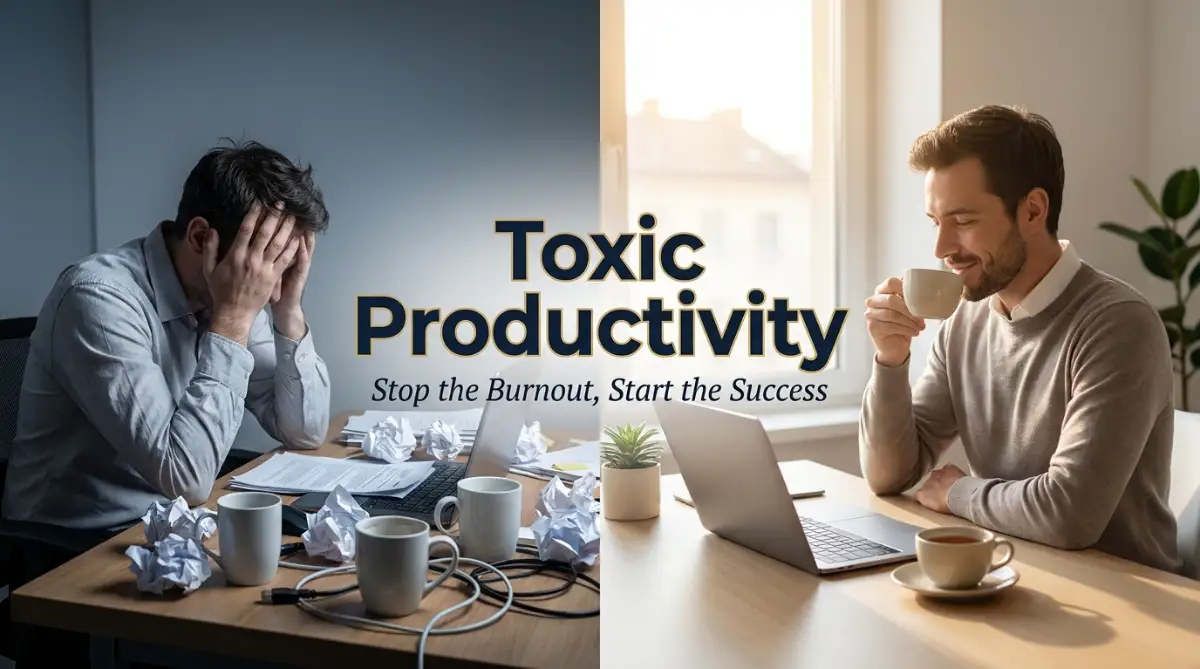
I remember waking up at 4 AM every single morning, completely convinced that I was on the absolute fastest path to massive success. My eyes were always burning, my coffee was usually cold by the time I drank it, and my brain felt like absolute mush by noon. I forced myself to work 14-hour days because every motivational speaker online told me I just needed to grind harder. But instead of getting closer to my big goals, I only managed to get physically sick and deeply depressed. My relationships suffered terribly, and my bank account barely moved an inch. I was unknowingly a massive victim of toxic productivity, chasing a finish line that always seemed to move further away.
You might be feeling the exact same heavy weight on your chest right now. The morning alarm goes off, and before your feet even touch the floor, a massive wave of guilt hits you. You immediately start thinking about all the unfinished tasks you left behind yesterday.
So, you skip a healthy breakfast, cancel weekend plans with your friends, and stare directly at a glowing screen until your eyes blur. Modern society constantly tells us that resting is just another word for being lazy. We are completely terrified of taking a normal break because we think someone else will steal our spot.
This constant fear slowly eats away at your daily mental peace. You are literally surviving on cheap caffeine and sheer daily panic. Your family asks for just five minutes of your attention, but you snap at them because you are simply too tired to think straight.
The absolute worst part of this cycle is the deep emptiness you feel at the end of the day. You might have checked off twenty different small tasks, but deep down you know none of them actually mattered.
You are basically running full speed on a treadmill, sweating and panting, but staying in the exact same place.
Unmasking the Hustle Illusions Holding You Back
To actually solve this exhausting problem, we need to completely change how we view a standard workday. We have been fed a lot of bad advice over the years. Let us break down the biggest lies you probably believe right now, and replace them with scientifically backed, practical steps you can start using today.
Breaking the 14-Hour Workday Fantasy
Most people believe that if they just sit at their desk for twelve or fourteen hours, they will naturally produce more output. This is a massive lie that completely ignores human biology. Your brain is not a machine that runs on electricity.
Our minds run on a very limited supply of daily cognitive energy. When you try to force yourself to work past your natural limit, you experience something scientists call the law of diminishing returns. This means that after a certain point, every extra hour you work actually produces worse results.
Think of your brain like a wet sponge. You can squeeze a lot of water out of it during the first few squeezes. But if you keep squeezing a dry sponge, you will not get any more water, you will just tear the sponge apart. Working longer does not equal working better.
Instead of counting your hours, you need to start counting your daily energy levels. You can get more meaningful work done in four hours of deep, undisturbed focus than you can in twelve hours of distracted, exhausted typing.
Why Doing Everything at Once is Destroying Your Focus
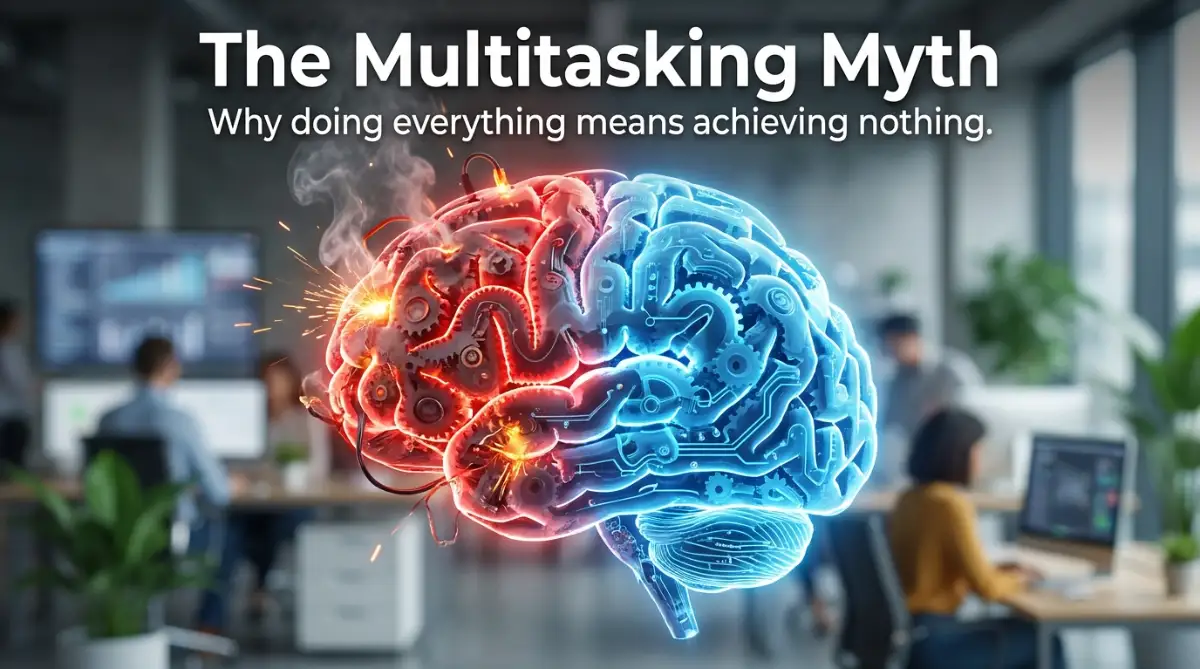
We love to praise people who can juggle ten different tasks at the exact same time. Society calls them super-achievers, but neuroscience calls them highly inefficient. Multitasking is completely impossible for the human brain.
When you think you are doing three things at once, you are actually just rapidly switching your attention between them. Every single time you switch your focus from an email to a project, your brain burns a massive amount of energy. This constant switching leaves what researchers call "attention residue" behind.
This means a part of your brain is still thinking about the previous task while you are trying to focus on the new one. This is exactly why you feel so incredibly tired by lunch time even if you have not done any physical labor. You are burning out your mental engine.
Are you ready to stop frying your brain and actually get things done? Check out this powerful visual breakdown of how single-tasking can completely change your workflow.
The Dangerous Illusion That Rest is for Failures
There is a very popular saying on the internet that goes, "I will sleep when I am dead." This is probably the most toxic and physically dangerous productivity myth ever created. Sleep is actually your brain's primary tool for success.
When you cut back on your sleep to work more, you are literally stealing from your future self. During deep sleep, your brain actually cleans out toxic proteins that build up during the day. If you do not sleep enough, those toxins stay in your brain, causing brain fog, poor memory, and terrible decision-making skills.
You might think you are getting ahead by staying up until 2 AM. But the work you produce in that exhausted state will likely be full of mistakes. You will then have to spend your precious time the next day fixing those exact same mistakes.
I used to force myself to follow a strict four-hour sleep schedule because I thought it made me a harder worker. My entire body physically crashed after just three weeks, and it took me a full month to recover my normal energy levels. I finally realized that treating sleep as a luxury was the exact reason I kept failing my biggest goals.
Confusing Fake Motion with Meaningful Action
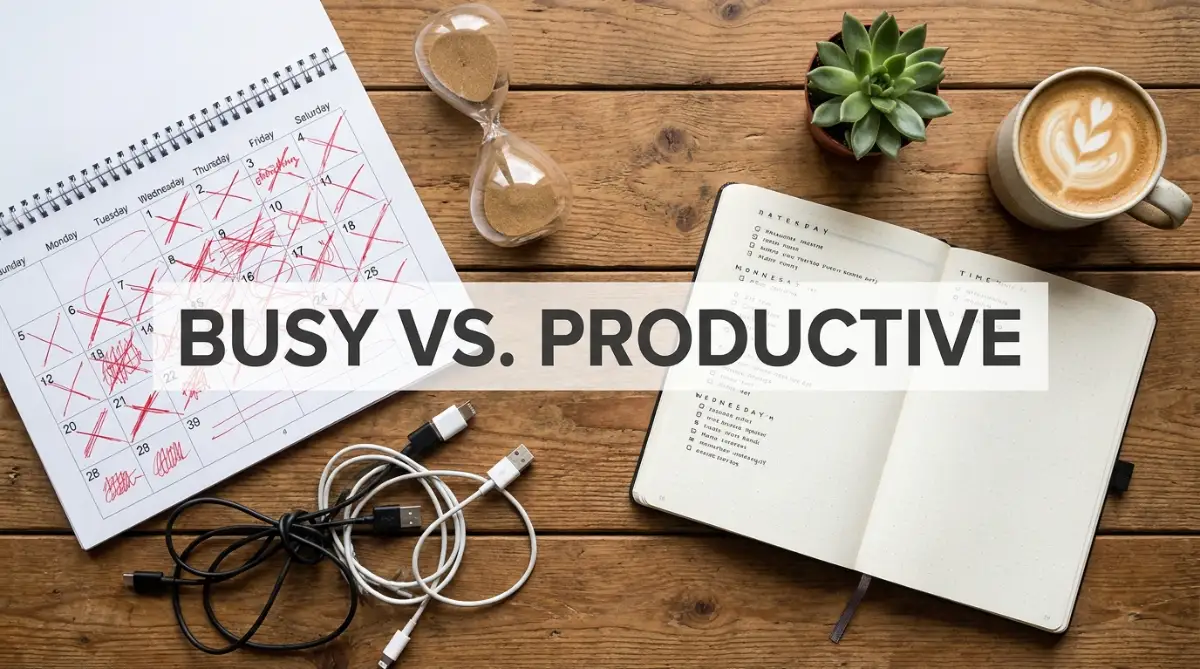
It is very easy to feel productive when your fingers are moving quickly across a keyboard. Replying to slack messages, organizing your messy digital folders, and color-coding your notes feels really good. But feeling productive and actually being productive are two completely different things.
This is the classic trap of confusing simple motion with meaningful action. Motion is anything that keeps you busy but does not actually move you closer to your main goal. Action is doing the hard, scary work that directly impacts your success.
Imagine sitting in a comfortable rocking chair. You are moving back and forth constantly, using plenty of energy. But you are not actually going anywhere at all. That is exactly what fake work does to your daily schedule.
We often hide behind fake work because the real work is intimidating. Writing the first chapter of your book is scary, but formatting the title page is easy. You have to stop hiding behind easy tasks.
A Quick Look: Meaningful Action vs Fake Work
The Suffocating Grip of Extreme Calendar Blocking
Time blocking is a great tool, but many people take it to a highly toxic extreme. They schedule every single minute of their day from the moment they wake up until the moment they sleep. They leave zero room for the natural chaos of human life.
When your calendar looks like a solid wall of colorful blocks, you are setting yourself up for a massive mental breakdown. Life is completely unpredictable. A client might call with an emergency, or your child might suddenly get sick at school.
If your schedule is packed so tightly that you cannot breathe, one single interruption will ruin your entire day. You will feel like a massive failure just because a meeting ran ten minutes late. Your schedule should be a flexible guide, not a strict prison cell.
You absolutely must build empty space into your daily routine. This empty space acts as a shock absorber for when things naturally go wrong. It gives your mind a chance to rest, process information, and calmly prepare for the next challenge.
Ignoring the Power of Intentional Boredom
In our modern society, we are absolutely terrified of being bored for even a single second. If we have to wait in line at the grocery store, we immediately pull out our phones. We constantly feed our brains cheap dopamine to avoid sitting alone with our thoughts.
But intentional boredom is actually the secret birthplace of human creativity. When you allow your mind to wander without any digital distractions, it starts connecting different ideas in the background. This is exactly why you always get your best ideas while taking a warm shower.
By filling every quiet moment with a podcast, a video, or an article, you are suffocating your own creativity. Your brain desperately needs quiet time to process everything you have learned throughout the day. Constant input means zero original output.
You need to start scheduling what I call "Junk Time" into your week. This is an hour where you have absolutely no goals, no screens, and no expectations. You can just sit on your porch, watch the clouds, or take a slow walk without headphones.
Stop Treating Yourself Like a Broken Machine
The core problem with toxic productivity is that it forces you to view your own body as a machine that needs to be optimized. You start measuring your basic human worth by how much you can produce in a twelve-hour window. You are a human being, not a factory assembly line.
Machines do not need to feel loved, they do not need to laugh, and they do not need to rest. When you try to act like a machine, you slowly strip away everything that makes life actually worth living. You stop enjoying your hobbies because they do not make you money.
You need to remember that your career is just one small part of your existence. Success means absolutely nothing if you are too sick, stressed, or lonely to actually enjoy it. Real productivity is about managing your energy so you can live a better life, not just do more work.
Advanced Methods to Reprogram Your Daily Routine
Now that we understand the deep psychological traps holding us back, it is time to take real action. Fixing a broken mindset does not happen overnight. You need a solid, practical system to slowly teach your brain how to work smarter.
These are not the typical generic tips you read in every motivational magazine. These are field-tested strategies based on human psychology and natural biology.
Mastering the Art of Energy Mapping
You have probably spent years trying to organize your time, carefully planning every hour of your day. But time is actually a terrible thing to measure because all hours are not created equal. An hour spent working at 8 AM feels completely different than an hour spent working at 4 PM.
Instead of tracking your time, you need to start tracking your daily energy levels. Pay close attention to your body for an entire week. Notice exactly when you feel naturally alert and when you suddenly want to take a nap.
Some people are incredibly sharp right after breakfast. Others do not hit their natural creative peak until the late afternoon. The National Institute of Mental Health explains that fighting your body's natural rhythms directly causes massive stress and mental fatigue.
Once you find your two or three highest energy hours, guard them aggressively. Do your absolute hardest, most difficult tasks during this small window. Leave the easy things, like checking emails or attending basic meetings, for the times when your brain is naturally tired.
The Power of the "Done Enough" List
We are all very familiar with a standard to-do list. The problem is that a traditional to-do list never actually ends. The moment you cross off three items, four more items magically appear at the bottom.
This creates a constant feeling of failure, no matter how hard you work. To fix this, you should start writing a daily "Done Enough" list. This is a very short list of just three essential tasks for the day.
If you finish these three specific things, your workday is officially considered a success. It does not matter what else happens, you have earned the right to relax. This simple mental shift gives your brain a clear finish line to cross every single day.
When you have clear boundaries, you avoid the anxiety of endless work. You might even want to check out broad lifestyle tips on Infozonee to see how setting small daily goals improves your overall well-being. A clear finish line allows you to finally close your laptop and actually enjoy your evening.
Strategic Disconnection as a Daily Habit
Your smartphone is the ultimate enemy of deep, focused work. Every single time your phone buzzes, it completely shatters your concentration. It takes an average of twenty minutes to regain your focus after just one tiny interruption.
You must build periods of strategic disconnection into your normal routine. This means physically putting your phone in a completely different room while you do your heavy work. Do not just put it face down on your desk, because your brain will still actively think about it.
If your job requires you to be online, use software blockers to silence non-essential notifications for a few hours. According to research published by the American Psychological Association, constant digital interruptions are a leading cause of workplace anxiety.
You need to train your brain to be comfortable with silence again. At first, you will feel a strong panic, like you are missing something incredibly important. But after a few days, you will experience a sense of mental clarity you have not felt in years.
Taking Vacations Without Carrying the Guilt
One of the best ways to reset a burnt-out mind is to completely change your physical environment. However, many people take vacations but bring all their work stress with them. They sit by the beach, constantly refreshing their work email.
A vacation is not a real break if your mind is still sitting in the office. You have to be brave enough to delete your work applications from your phone before you pack your bags. If you are worried about traveling safely, you can always look into securing comprehensive travel coverage to ease your mind about emergencies.
The point is to remove all unnecessary worries from your plate. When you completely disconnect, you give your nervous system a much-needed chance to heal. You will return to your desk with ten times more creativity and energy than before.
The Silent Traps That Will Pull You Back In
Breaking free from toxic work habits is a very emotional journey. Your brain is deeply addicted to the feeling of constantly being busy. Even when you try to rest, your own mind will play tricks on you to pull you back into the hustle.
It is incredibly easy to slip back into your old ways without even realizing it. Here are the most dangerous psychological traps you will face, and exactly how they can silently destroy your progress.
Measuring Your Human Worth by Output
This is the most heartbreaking mistake people make. We have been conditioned from a young age to believe that our value as a person comes from what we produce. If we have a highly productive day, we feel like a good person.
If we take a day off to just watch movies on the couch, we feel like a total failure. You have to actively separate your self-worth from your daily output. You are a valuable human being simply because you exist, not because you finished a big project on time.
When you tie your identity to your work, losing a job or failing a business feels like literal death. This is why understanding the hidden legal protections of business is helpful, but guarding your emotional health is even more important. A business can always be rebuilt, but a broken spirit takes years to heal.
You must remind yourself daily that you are more than your job title. Your worth is found in how you treat others, how you laugh, and how you experience the world.
The Revenge Bedtime Procrastination Trap
Have you ever stayed up until 3 AM mindlessly scrolling through social media, even though you were completely exhausted? This is a known psychological phenomenon called revenge bedtime procrastination. It happens when you have zero control over your daytime hours.
Because you spent your entire day working for other people, your brain refuses to go to sleep. It desperately wants to steal back a few hours of personal freedom, even if it means ruining your health. This is a massive warning sign that your current schedule is suffocating you.
By skipping sleep, you are guaranteeing that tomorrow will be even harder and more stressful. According to experts studying cognitive behavior at Nature Research Journals, severe sleep deprivation mimics the exact same brain patterns as chronic burnout.
To stop this vicious cycle, you need to schedule personal joy into your afternoon. If you give yourself an hour to read or play a game at 6 PM, your brain will not feel the need to seek "revenge" at midnight.
Buying Tools Instead of Changing Mindsets
When people finally decide they want to get organized, the first thing they do is open their wallets. They buy expensive leather planners, premium time-tracking software, and entirely new desk setups. They honestly believe that spending money will magically fix their deep-rooted habits.
I once spent over a hundred dollars on a beautiful journaling system, thinking it would cure my procrastination. All it did was sit on my shelf and make me feel terribly guilty every time I looked at it. A shiny new tool cannot fix a broken internal system.
Before you buy anything new, you must change how you think about your work. If you are struggling with financial anxiety while trying to fix your habits, you might even look into managing your home budget safely. Fixing the core root of your stress is always better than applying an expensive, temporary bandage.
Start with a cheap spiral notebook and a plain pen. If you can build a healthy routine with basic tools, you will eventually succeed with anything.
Ignoring the Physical Warning Signs
Your body is incredibly smart. Long before your mind realizes you are burnt out, your physical body will try to warn you. Unfortunately, most of us just ignore these clear warning bells.
It usually starts with strange tension headaches right behind your eyes. Then, your shoulders start feeling like they are made of solid concrete. Instead of resting, we usually just take pain medicine and push through the obvious discomfort.
Eventually, this chronic stress starts destroying your immune system and your digestion. Many people turn to quick fixes, and while exploring safe wellness solutions can help with physical health, they cannot outwork a terrible daily routine. You cannot supplement your way out of severe sleep deprivation.
When your body whispers that it is tired, you must listen immediately. If you ignore the quiet whispers, your body will eventually scream, forcing you to stop working altogether through a major illness.
Reclaiming Your Life and Finding True Balance
We have covered a massive amount of ground today. You now clearly understand that the endless hustle is a dangerous illusion designed to keep you exhausted. Working fourteen hours a day does not make you a hero, it just makes you a very tired human being.
You have learned that your brain requires periods of absolute silence to generate its best ideas. You now know that multitasking is physically impossible, and that resting is an absolute requirement for long-term success.
The hardest part of this entire journey is unlearning everything you thought was true. Society will constantly try to pull you back into the rat race. Your coworkers might even brag about how little sleep they get, wearing their exhaustion like a weird badge of honor.
You must be strong enough to smile, nod, and walk away from that toxic environment. Real success is waking up feeling rested, enjoying a slow morning coffee, and doing meaningful work without burning your soul to the ground.
Take a deep breath and look at your current schedule. Find just one single meeting you can cancel, or one task you can push to next week. Give yourself the incredible gift of free time today, because nobody else is going to give it to you.
I finally learned to close my laptop at 5 PM without feeling guilty, and it completely saved my health and my marriage. My biggest wish for you is that you stop treating your worth like a heavy checklist, and start actually living the beautiful life you are working so hard to build.
Common Questions About Overcoming Hustle Culture
What is the clearest sign that my work habits are toxic?
The biggest warning sign is feeling deeply guilty whenever you try to relax. If you sit down to watch a movie and your chest feels tight because you are not working, you have a toxic relationship with productivity. Your brain has forgotten how to simply exist without producing something.
How do I stop feeling guilty when I take breaks?
You have to reframe how you look at rest. Stop viewing a break as a reward for hard work, and start viewing it as the necessary fuel for your next task. Just like a car needs gas to drive, your brain needs rest to function properly.
Does taking frequent breaks actually make you faster?
Yes, absolutely. When you work for hours without stopping, your brain slows down and you start making very sloppy mistakes. Taking a ten-minute walk completely resets your cognitive focus, allowing you to finish the task twice as fast when you return.
How can I set healthy boundaries at a demanding job?
Start by setting very small, quiet boundaries that nobody can argue with. For example, stop answering emails after 6 PM, and do not reply to weekend messages until Monday morning. When people realize you are not available 24/7, they will naturally stop expecting immediate replies.
Can toxic productivity cause physical health issues?
It absolutely can. Pushing your body past its limits constantly floods your system with cortisol, the stress hormone. Over time, this leads to chronic insomnia, high blood pressure, and severe digestive issues.
What should I do if I feel completely burnt out right now?
The very first step is absolute, unapologetic rest. Do not try to fix your entire life today; just focus on getting a full eight hours of sleep tonight. Once your energy slowly returns, you can begin removing the bad habits that caused the burnout in the first place.
Disclaimer: The information provided in this article is for educational and informational purposes only. It is not intended to be a substitute for professional medical advice, psychiatric diagnosis, or therapy. Always seek the advice of a qualified mental health provider with any questions you may have regarding chronic stress or severe burnout.