The Crushing Reality of the Unending Red Match History
You stare blankly at your monitor, the glow of the screen reflecting off your tired eyes. Your match history is an absolute sea of red, with endless defeat screens mocking your efforts. Just a few days ago, you were climbing the ranks effortlessly, hitting your shots, and feeling like an absolute professional. Now, it feels like the game itself has decided you no longer deserve to win.
This is not just a minor frustration. It is a deeply demoralizing experience that genuinely ruins your mood long after you shut down your PC. You start doubting your own skills, wondering if your reaction time has suddenly disappeared overnight. You ask yourself why every single match feels like an uphill battle where your teammates are lost, and the enemy team consists of unstoppable aim gods.
The worst part is the emotional toll this takes on your daily life. You sit down to play your favorite tactical shooter to unwind after a long, exhausting day of work or study. Instead of relaxing, your heart rate spikes, your stress levels shoot through the roof, and you go to bed feeling completely defeated. The mental exhaustion spills over into your next morning.
I want to assure you right now: you have not suddenly forgotten how to play.
The mechanics of modern competitive games are incredibly complex, and there are hidden systems working against you. Let us break down exactly what is happening to your account and your mind, and how you can take control back from the algorithm today.
The Algorithm's Secret Rules: Hidden MMR vs. Visible Rank
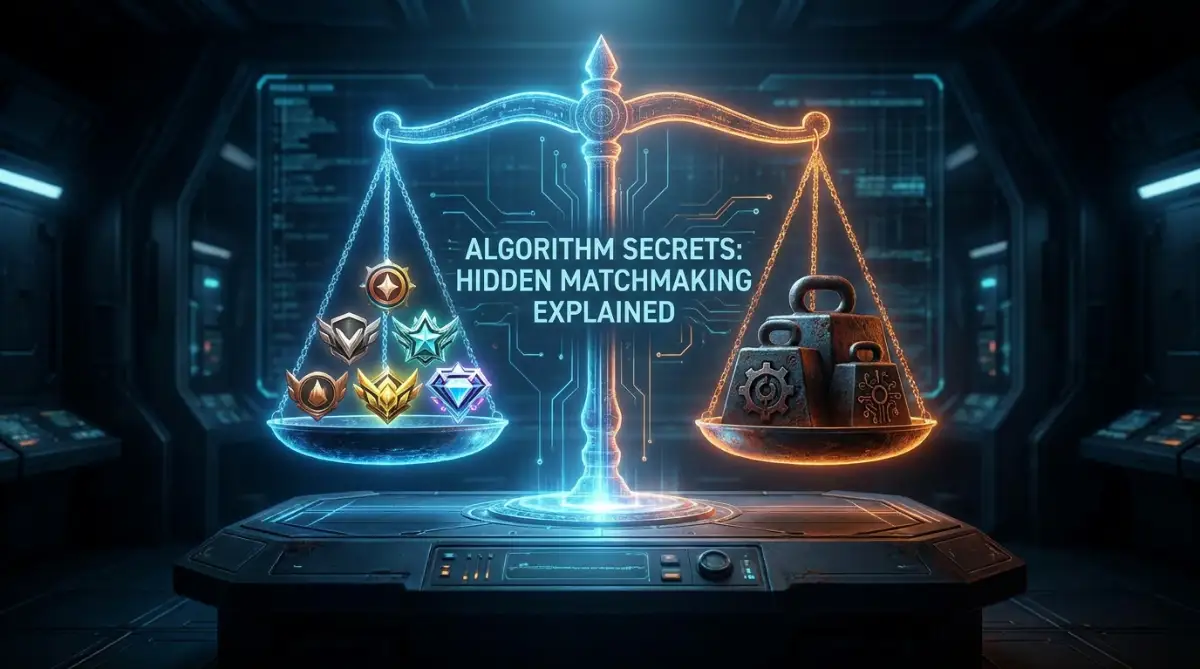
Most players completely misunderstand how their rank actually works. You see a shiny gold or platinum badge next to your name and assume that is your true skill level. However, underneath that visual badge lies a secret, invisible number known as your true Matchmaking Rating.
Your visible rank is mostly just a cosmetic reward to make you feel good about your progression. The game’s servers completely ignore your shiny badge when finding your next match. Instead, the algorithm only looks at your hidden matchmaking number to decide who you play against. This creates a massive disconnect between what you expect and what the game delivers.
The Rubber Band Effect
Imagine your hidden rating and your visible rank are connected by a tight rubber band. If you go on a lucky winning streak, your visible rank shoots up very fast. But your hidden rating moves much slower because the system needs proof that you actually belong in that higher skill bracket permanently.
Because your visual rank is now artificially higher than your hidden number, the algorithm starts testing you aggressively. It intentionally places you in lobbies where the odds are slightly stacked against you. If you lose these test matches, the rubber band snaps back violently. The system punishes your visible rank heavily to pull it back down to your hidden baseline.
This is why a single loss suddenly deletes hours of hard-earned progression. The game algorithm is correcting what it views as a temporary mathematical error. Understanding this simple fact immediately removes the mystery behind those massive point deductions.
The Silent Killer: Cognitive Fatigue and Decision Paralysis
When we talk about aiming and clicking heads, we usually think of physical mechanics. But tactical shooters are actually games of high-speed mental chess. Every single second, your brain is processing audio cues, checking the mini map, managing economy, and predicting enemy movements.
This constant data processing burns an immense amount of mental energy. After just two or three intense matches, your brain enters a state of cognitive fatigue. You might still feel completely awake, but your subconscious processing speed has actually dropped dramatically.
Pro Tip for Mental Energy:
Never queue up for a ranked match immediately after a highly stressful overtime loss. Your nervous system is flooded with adrenaline, and your decision-making center is completely exhausted. Force yourself to stand up, drink a full glass of water, and look at something far away for at least five minutes before clicking the "Find Match" button again.
When cognitive fatigue sets in, you stop making proactive plays. Instead of predicting the enemy sniper's position, you lazily walk around the corner and rely purely on your physical reaction time. In highly competitive lobbies, relying purely on raw aim while your brain is tired is a guaranteed way to lose engagements.
This leads directly into the dreaded concept of "Tilt." Tilt is not just feeling angry; it is a documented psychological state where your logic centers shut down entirely. You start making overly aggressive, highly risky plays because you are desperate to win back the points you just lost. This desperation creates a terrible feedback loop, resulting in the sudden, catastrophic rank drops you are experiencing right now.
Unnoticed Meta Shifts and Patch Note Blindness
Sometimes the reason you are losing has absolutely nothing to do with your psychology or your aim. Game developers are constantly tweaking character abilities, weapon recoil patterns, and map geometry. A tiny update that changes a weapon's equip time by just 0.2 seconds can entirely destroy your muscle memory.
Myth vs Reality in Game Updates:
- The Myth: Minor patch notes only affect professional esports players.
- The Reality: Small numeric changes completely alter the flow of a match. If a specific smoke grenade now lasts one second shorter, your perfectly timed site execution will fail, exposing you to enemy fire.
Many players fall into the trap of playing the exact same way they did a month ago. They hold the exact same angles, buy the exact same weapons, and use the exact same strategies. But the game environment has quietly shifted around them. Your favorite weapon might have received a secret nerf to its running accuracy, causing you to miss shots you used to hit consistently.
If you suddenly hit a massive wall and start losing, you must review the latest game changes. Stop forcing an outdated strategy into a new mathematical environment. Adapting to the new rules is often the quickest way to stop your rating from bleeding out.
The Solo Queue Lottery and Team Synergy
Tactical shooters are heavily reliant on team coordination, trading kills, and crossfire setups. When you queue up alone, you are essentially spinning a roulette wheel for your teammates. The matchmaking system tries to balance the hidden numbers of both teams, but it cannot measure human emotions or communication skills.
The system might give you a teammate with a very high numerical rating who is currently playing with a broken microphone. Or, it might match you with players who exclusively play the exact same role you do. Suddenly, your team has three aggressive entry players and nobody willing to play support. This lack of synergy mathematically guarantees a heavy disadvantage before the round even starts.
Scenario Solo ~ Queue Impact Solution ~ Approach
Silent Teammates ~ Zero information gathering, constant flanks. ~ Play highly self-sufficient positions. Rely on mini map info.
Toxic Teammates ~ Destroys team morale, causes intentional throwing. ~ Mute immediately. Do not engage. Play your own game.
Role Clashes ~ Everyone fights for the same character or weapon. ~ Learn at least two completely different playstyles. Be flexible.
You cannot control who the game puts on your team. However, your reaction to bad teammates directly influences your matchmaking rating. If you start arguing in text chat, your own performance drops. The players who maintain their rank consistently are those who adapt to their chaotic teammates rather than fighting them.
Hidden Hardware and Network Inconsistencies
Let us move away from human errors and look directly at your equipment. Tactical shooters operate on incredibly tight margins where milliseconds determine who wins a gunfight. If your system is suffering from micro-stutters or minor network instability, you will lose fights without even realizing it.
We are not just talking about massive lag spikes that freeze your screen. The real danger comes from invisible packet loss and subtle input delay. Your screen might show you clearly clicking on the enemy's head, but your internet router delayed sending that information to the main server by just 30 milliseconds. The server decides the enemy shot first, and you instantly die.
You must regularly audit your technical setup. Background applications silently downloading updates can throttle your bandwidth mid-match. Dust buildup inside your computer case causes your processor to slightly overheat, secretly dropping your frame rate during intense visual moments like smoke deployments or explosions.
To protect your rank, you need a stable environment. Lock your frame rate to match your monitor's refresh rate exactly to prevent screen tearing. Connect your computer directly to the router using a physical cable instead of relying on unstable wireless connections. Eliminating these tiny technical bottlenecks ensures that when you lose a fight, it is entirely based on skill, not a secret hardware failure.
Mastering the Mental Sandbox: Long-Term Strategies for Consistent Ranking
To completely stop sudden rating drops, you have to change how you approach the game entirely. Most players load into a server with only one thought in their head: they just want to see the victory screen. This mindset actually sets you up for massive failure.
Instead, you need to adopt a strategy known as deliberate practice. Think about how you learned to ride a bicycle or drive a car. In the beginning, you focused deeply on every single pedal push or steering wheel movement. But over time, your brain put these actions on autopilot to save energy.
In highly competitive tactical shooters, playing on autopilot is a death sentence. The moment you stop actively thinking about your positioning, the enemy will outsmart you. You must actively train your brain to stay present during every single round.
The Power of VOD Reviewing
One of the greatest secrets used by professional esports athletes is recording their own matches. This practice is often called VOD (Video on Demand) reviewing. When you are actually playing, your adrenaline is pumping, and you cannot clearly see your own mistakes.
Watching a replay of your worst loss completely removes that emotional stress. You can pause the video, look at your screen, and honestly ask yourself why you died in that specific moment. Were you looking at the floor instead of head height? Did you ignore a clear sound cue from the left side?
You will be genuinely shocked at how obvious your mistakes look when you watch them as a spectator. Recognizing these errors is the first massive step toward fixing them permanently. Just as investors benefit from unmasking crypto volatility: what everyone gets wrong about market risks to prevent emotional decisions, gamers must understand their own hidden flaws to prevent algorithmic panic.
Setting Actionable Micro-Goals
Another incredibly powerful method is breaking your gameplay down into micro-goals. Instead of making your goal "I need to win this match," make it something completely within your own control. For example, tell yourself, "In this match, I will focus entirely on not dying early in the round."
When you achieve this small goal, your brain releases dopamine, even if your team ultimately loses the match. This protects your mental energy from completely collapsing during a losing streak. It shifts your focus from the hidden mathematical algorithm directly onto your personal mechanical improvement.
Real scientific data backs up this approach to mental load management. According to research published on cognitive demands in esports by Frontiers in Psychology, managing your working memory capacity directly prevents performance degradation. By focusing on just one micro-goal at a time, you keep your brain sharp and avoid feeling overwhelmed by chaotic team fights.
The 30-40-30 Matchmaking Philosophy
You must also embrace the reality of competitive numbers. There is a famous concept among high-ranking players known as the 30-40-30 rule. Mathematically, you are guaranteed to completely lose 30% of your games because of bad teammates or smurfing enemies.
On the flip side, you will easily win 30% of your games because your team carries you without you doing much work. The entire ranking system actually revolves around that remaining 40%. Those middle matches are perfectly balanced, and your personal performance determines the final outcome.
If you obsess over the 30% of games you were destined to lose anyway, you will destroy your confidence. Accept those guaranteed losses with a smile, save your mental energy, and prepare to try hard during the matches that actually matter.

The Self-Sabotage Trap: Habits That Destroy Your Rating
Understanding how to improve is great, but knowing exactly what pitfalls to avoid is equally necessary. When players experience a sudden drop in their hidden numbers, panic sets in immediately. This panic forces smart people to make completely irrational, self-destructive choices.
Let us explore the most dangerous psychological and technical traps that keep players stuck in an endless cycle of deranging.
The "Revenge Queue" Phenomenon
This is perhaps the most common and damaging mistake you can make. You just lost a terribly unfair match, your rank dropped, and you feel angry. Instead of walking away, you instantly click "Find Match" again because you desperately want to win those lost points back.
This is known as revenge queueing, and it shares the exact same psychological profile as terrible casino gambling. You are entering the next game already frustrated, impatient, and expecting your new teammates to fail. Your communication becomes toxic immediately, and you take unnecessary in-game risks.
If you lose two matches in a row, you must physically step away from the computer. Go outside, grab a snack, or watch a funny video. Forcing a third match while your brain is boiling with frustration mathematically guarantees a third loss.
Constantly Altering In-Game Settings
When you miss an easy shot, it is extremely tempting to blame your mouse. You immediately open your settings menu and lower your mouse sensitivity. Ten minutes later, you miss another shot, so you change your crosshair color to green.
This is a catastrophic error that permanently damages your mechanical consistency. Your muscle memory requires highly consistent inputs to develop automatic reflexes. Much like the careful process of building a private AI brain and safely training models on your data, feeding your own brain wildly different mouse sensitivities every single day completely breaks your learning process.
According to studies on motor skill consolidation by the National Institutes of Health (NIH), it takes significant time and consistent repetition for your brain to lock in physical reflexes. Pick a comfortable sensitivity, choose a simple crosshair, and force yourself to stick with them for at least a full month. Stop blaming your perfectly fine hardware for basic human errors.
Bringing Real-World Stress into the Server
Your physical and emotional state outside of the game directly impacts your reaction speed inside the game. If you slept for only four hours last night, your visual processing speed is significantly delayed. You will physically see the enemy slower than they see you.
Furthermore, extreme real-world anxiety totally destroys your ability to focus on virtual problems. If you are deeply stressed about real-world financial issues—like trying to figure out how to secure fast unsecured bank loans for immediate cash—your mind will wander during quiet moments in the match. You will zone out, miss a footstep sound, and lose the round for your team.
Video games are meant to be an escape, but competitive modes require intense mental presence. If you are having a terrible day in real life, do not load into a ranked match. Play a casual game mode, or better yet, get some rest to protect your hard-earned rating.
The Blame Game Deflection
It is incredibly easy to point fingers at the player at the bottom of the scoreboard. You might feel totally justified in typing angry messages to a teammate who keeps dying early. However, focusing heavily on someone else's mistakes completely blinds you to your own.
You cannot control a random stranger on the internet. You cannot press their keyboard for them or improve their aim. Every second you spend complaining about their bad plays is a second you waste not fixing your own positioning. The best players in the world completely ignore bad teammates and focus solely on how they can carry the heavy burden themselves.
Reclaiming Your Rank: Your Personal Action Plan
We have covered the secret math behind the algorithm, the severe danger of mental fatigue, and the deadly traps of self-sabotage. Now, it is time for you to take back control of your match history. You no longer have to fear sudden rating drops because you now understand exactly why they happen.
Starting today, your approach to climbing the ladder is going to be completely different. Before you even open the game, check your own mood. Are you actually energized and ready to focus, or are you just playing out of a boring daily habit?
Your Pre-Match Checklist:
- Warm up mechanically: Spend exactly ten minutes shooting training bots or playing a quick deathmatch to wake up your hands.
- Set a specific goal: Decide on one single thing you want to improve today, completely ignoring whether you win or lose the match.
- Commit to the 2-Loss Rule: Promise yourself right now that if you lose two matches consecutively, you will close the game for the rest of the night.
If you follow this exact mental framework, your hidden rating will slowly but permanently stabilize. You will stop experiencing those wild, terrifying drops that delete weeks of progress. Your aim will feel naturally sharper because your mind is finally clear and rested.
Remember, the colorful badge next to your name does not define your actual worth as a player. The true joy of tactical shooters comes from noticing your own gradual improvement. Keep your head held high, communicate positively with your team, and enjoy the incredible journey of mastering the game.
Disclaimer for our Readers:
The information provided in this article is strictly for educational and entertainment purposes related to competitive gaming strategies. It does not guarantee specific ranking improvements or esports success. Individual results will always vary based on personal skill, hardware quality, and continuous game updates. Please remember to balance your gaming sessions with healthy real-world habits and regular physical screen breaks.