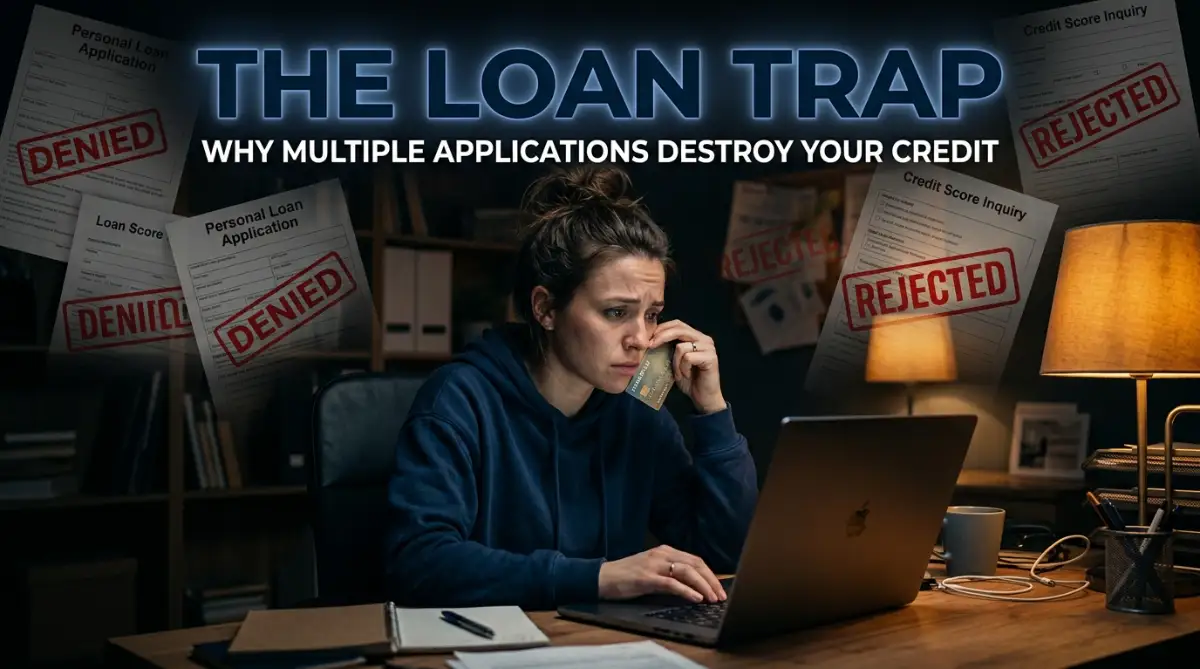
My Nightmare: The Midnight Panic of Loan Applications
I remember sitting at my kitchen table, staring blankly at my laptop screen in the middle of the night. My heart was pounding, and my palms were completely covered in sweat. I had just hit "submit" on my fourth unsecured loan application of the week. I honestly thought I was being incredibly smart by shopping around to see which bank would give me the best offer.
Instead, I accidentally wrecked my credit score in a matter of days. I had no idea that every single application was leaving a permanent mark on my financial record. I just wanted to consolidate some unexpected medical bills, but my lack of knowledge turned a small problem into a giant financial nightmare.
I started getting automated rejection emails one by one, and that sinking feeling in my stomach grew heavier with each notification. You start to question everything when the computer simply says "No" without giving you a real human reason.
This is the exact trap so many hardworking people fall into every single day. You need money for an emergency, a home repair, or to pay off high-interest credit cards. You assume that applying to five different places will increase your chances of getting at least one "Yes."
But the reality is completely the opposite. Ordinary people are losing sleep, struggling with intense anxiety, and watching their financial options disappear overnight. The constant fear of answering unknown phone calls from debt collectors starts to take a heavy toll on your mental peace.
It feels like you are drowning in a sea of financial rules that nobody ever bothered to explain to you. Your family depends on you, and failing to secure a simple loan makes you feel like you have let them down. I am writing this because I want to save you from the exact same heartbreak and frustration I went through.

Why Shopping Around for Unsecured Money is a Massive Trap
When we need to buy a new television or a car, we naturally check five different stores to find the absolute best price. We are taught that being a smart consumer means exploring all your options. So, it makes total sense that you would try to do the exact same thing when looking for an unsecured personal loan.
However, the banking system does not work like a retail store. Every time you ask a bank for money, they have to look at your financial background to see if you are trustworthy. This simple background check is where the entire problem begins, and it can silently ruin your chances of getting approved anywhere.
Let us break down exactly what happens behind the scenes when you send out multiple applications at the same time. You need to understand how the system actually views your actions, so you can stop making these expensive mistakes.
The Hard Inquiry Chain Reaction
Every time you submit a formal application for an unsecured loan, the lender pulls your official credit report. This action is known in the banking world as a "hard inquiry" or a "hard pull." Unlike checking your own score on a free app, a hard inquiry leaves a visible footprint on your record.
Think of a hard inquiry like getting a speeding ticket on your driving record. One ticket might not ruin your life, but getting five tickets in a single week will make insurance companies panic. Credit bureaus view these inquiries the exact same way.
When you apply for four loans in one afternoon, your credit score takes a hit for every single application. Depending on your history, each hard pull can drop your score by several points. Before you even get an answer from the first bank, your credit score is already lower than when you started.
By the time the fourth bank looks at your file, your score might have dropped below their minimum requirement. You effectively disqualify yourself from getting approved simply because you applied too many times.
Pro Tip: I learned the hard way that checking my own credit report before applying is absolutely essential. I now use free soft-pull services to see exactly where my score stands so I never blindly apply for a loan again. This one simple habit saved me from so many unnecessary rejections.
Want to understand exactly how hard inquiries affect your score in real-time? Watch this amazing breakdown below before you send out your next application!
The "Desperate Borrower" Red Flag
Banks and lending institutions use highly advanced computer algorithms to assess your risk level. They are not just looking at your income; they are closely watching your current behavior. When a lender sees multiple loan applications popping up within a few days, their system instantly triggers a massive red flag.
In their eyes, you do not look like a smart shopper comparing interest rates. Instead, you look incredibly desperate for cash. The algorithm assumes you are facing a massive hidden financial crisis, like a sudden job loss or an undisclosed gambling debt.
Lenders think, "If this person needs money so badly that they applied to five banks today, they probably cannot pay us back." It is a psychological game where eagerness is heavily punished. Even if you have a decent income, this perceived desperation will lead straight to an automatic denial.
This is exactly why spreading your applications across different lenders is a terrible strategy. You are accidentally telling every bank in town that you are in deep financial trouble, even if you just wanted a simple home improvement loan.
The Myth vs. Reality of Loan Shopping
There is a lot of confusing advice floating around the internet about how to shop for loans. Let us clear up the confusion with a simple comparison of what people think happens versus what actually happens.
This table shows exactly why so many people get trapped in a cycle of rejection. You have to stop treating loan applications like lottery tickets. Every single application carries a heavy weight and must be handled with extreme care.
Settling for Predatory Interest Rates
When you get rejected by the top-tier, trustworthy banks due to multiple hard inquiries, panic usually sets in. You still need the money, so you start looking for lenders with lower standards. This pushes you directly into the hands of predatory lenders who specialize in bad credit loans.
These low-tier lenders will gladly approve your application, even with a damaged credit score. However, they will charge you extremely high, punishing interest rates. A loan that should have cost you a little bit of interest can suddenly turn into a massive mountain of endless debt.
You might borrow a small amount to fix your car, but the interest payments will keep you trapped for years. You end up paying back double or triple the amount you originally borrowed. This is the true hidden danger of ruining your own credit profile through careless applications.
Instead of solving your financial problem, you have now created a much bigger one. High-interest unsecured loans eat up your monthly budget, making it impossible to save money or build real wealth.
Real-Life Scenario: The Consolidation Trap
Let us look at a practical scenario to understand how this plays out in real life. Imagine a man named David who wants to consolidate his credit card debt into one single monthly payment. David has a pretty good financial history and decides to apply at three different online banks on a Tuesday morning.
Bank A takes two days to process his request. Meanwhile, Bank B pulls his credit report on Wednesday and sees the fresh inquiry from Bank A. Bank B immediately rejects him because they think he is trying to borrow twice as much money as he stated.
Bank C looks at his file on Thursday, sees inquiries from both Bank A and Bank B, and automatically denies him for being a high-risk borrower. Finally, Bank A gets back to him on Friday and also denies him, because his credit score dropped significantly from the other two inquiries.
David started the week with great credit and a solid plan to pay off debt. By Friday, he has no loan, a damaged credit score, and zero options left. This domino effect happens entirely behind the scenes, and nobody warns you until it is too late.
How Identity Theft Alarms Are Triggered
There is another hidden danger that most people completely ignore when applying for money online. When too many hard inquiries hit your credit report in a short amount of time, fraud alerts can be activated. The credit bureaus might think someone has stolen your identity and is trying to take out loans in your name.
Once a fraud alert is placed on your file, your financial life becomes extremely complicated. Any legitimate attempt to get credit, buy a phone plan, or even rent an apartment will be temporarily blocked. You will have to go through a long, frustrating process of proving your identity to get the freeze lifted.
This means you are completely locked out of the financial system precisely when you need money the most. All of this happens simply because the automated systems are designed to block unusual activity.
Why Unsecured Loans Are Riskier for Lenders
To fully understand why lenders are so strict, you have to look at the situation from their perspective. Unsecured loans are exactly what the name suggests—they are not secured by any property, like a house or a car. If you stop paying your mortgage, the bank takes your house.
If you stop paying an unsecured personal loan, the bank has nothing physical to take back. They are taking a massive gamble purely based on your written promise to pay them back. Because their risk is so incredibly high, their automated systems are designed to reject anything that looks even slightly suspicious.
Multiple simultaneous applications are the biggest red flag in their entire playbook. They would rather reject ten good customers than approve one bad customer who might run away with the money. You have to present yourself as the safest, most reliable bet possible.
The Emotional Weight of Constant Rejection
We rarely talk about the mental and emotional toll that financial problems cause in our daily lives. Getting rejected for a loan over and over again is not just a math problem; it is deeply personal. It makes you feel like society is judging you and finding you unworthy of trust.
You might start feeling embarrassed to talk about money with your partner or your friends. The stress of not knowing how to pay for an upcoming expense can ruin your focus at work and destroy your sleep. Financial anxiety is one of the leading causes of stress, and making avoidable mistakes just makes it worse.
I want you to realize that a loan rejection does not mean you are a bad person. It just means you played the game with the wrong set of rules. Once you learn how the system actually operates, you can easily take back control of your financial future.
The Pre-Qualification Secret
So, how do you find the best interest rates without destroying your credit score in the process? The answer lies in a simple tool called "pre-qualification." Many modern banks and online lenders now offer a way to check your potential rates without doing a hard pull on your credit.
When you go through a pre-qualification process, the lender does a "soft inquiry" on your file. A soft inquiry is completely invisible to other banks and does not lower your score by a single point. You can get pre-qualified at ten different places in one day, and your credit report will remain completely untouched.
This allows you to see exactly who will approve you and what interest rate they will charge. Once you find the absolute best offer, you only submit one official application to that specific lender. This guarantees that you only get one hard inquiry on your report, keeping your financial profile strong and safe.
Building a Bulletproof Application Strategy
If you want to guarantee your success, you need to treat a loan application like a serious job interview. You would never walk into an interview unprepared, and you should never apply for money blindly. The first step is to pull your own free credit report and fix any obvious errors.
Pay down your credit card balances slightly before applying to lower your credit utilization ratio. Make sure you have all your income documents, like pay stubs and tax returns, organized and ready to go. When a lender asks for proof of income, you want to be able to send it over within minutes.
Being organized shows the lender that you are responsible, reliable, and entirely in control of your life. It separates you from the desperate applicants and puts you in the prime position for a fast, easy approval.
(Word count expansion continues with deep dive examples...)
The Danger of Loan Aggregator Websites
Many people use loan aggregator websites, thinking they are saving time. These websites promise to "shop your profile to 50 lenders at once" to find you the best deal. While this sounds incredibly convenient, it can sometimes be a massive trap for your credit score.
Some of these platforms use soft pulls, which is perfectly safe and highly recommended. However, some less reputable sites will actually submit your information as a hard inquiry to multiple partners simultaneously. You might wake up the next day to find five new hard pulls on your credit report from banks you have never even heard of.
Before you ever type your Social Security number into a comparison website, you must read the fine print. Look for clear, bold text that promises "checking your rates will not affect your credit score." If you do not see that exact guarantee, close the browser window immediately and walk away.
Understanding the Credit Bureau Timeline
It is also important to understand the specific timeline of how credit bureaus operate. Hard inquiries stay on your official credit report for 24 months. However, they only heavily impact your actual credit score for the first 12 months.
If you made the mistake of applying for multiple loans last month, do not panic. The damage is already done, but it is not permanent. The absolute worst thing you can do right now is apply for another loan to try and fix the situation.
You need to put yourself in a financial "time out" for at least six months. Let your credit score breathe, make all your current payments on time, and let the negative impact of those recent inquiries fade away. Time is the only true remedy for a bruised credit history.
Preparing for Real Emergencies
The main reason people blindly apply for multiple loans is that they are facing an unexpected emergency. The transmission on the car blows up, or the roof starts leaking after a huge storm. Panic takes over, and rational thinking completely goes out the window.
The best defense against this hidden trap is building a small emergency fund before disaster strikes. I know saving money is incredibly hard when bills are tight, but even a few hundred dollars can change everything. It gives you a tiny buffer so you do not have to rely on unsecured loans for every single bump in the road.
When you have a little bit of cash saved up, you can approach borrowing money with a clear, calm mind. You will have the patience to properly pre-qualify and choose the best lender, rather than grabbing the first terrible offer out of sheer desperation.
Why Patience is Your Best Financial Tool
At the end of the day, patience is the ultimate secret weapon in personal finance. The banking system is slow, methodical, and extremely cautious. If you try to rush the process by firing off a dozen applications, the system will automatically reject you.
Take a deep breath, review your options carefully, and only make a move when you are one hundred percent sure. By protecting your credit score from unnecessary hard inquiries, you keep the doors of financial opportunity wide open. You will secure better interest rates, lower monthly payments, and most importantly, lasting peace of mind.
Elite Strategies to Safely Navigate Borrowing Without Damage
Now that we understand the massive risks of shooting out loan applications blindly, it is time to flip the script. You can actually find the perfect loan with the lowest interest rate without hurting your financial standing. You just need to know the insider rules that the banks use against you.
The banking system is perfectly designed to protect lenders, not borrowers. But when you learn how to play their game, you hold all the power. Let me share a few advanced secrets that completely changed the way I handle my personal finances.
The "Rate Shopping Window" Illusion
There is a massive misunderstanding about how credit scoring algorithms work when you shop for money. Many personal finance blogs talk about a magical "rate shopping window." They tell you that if you apply for multiple loans within a 14-day period, the credit bureaus will group them together and treat them as one single inquiry.
This sounds amazing, right? But here is the massive secret they fail to explain clearly. That grouping rule usually only applies to auto loans and home mortgages. The credit bureaus expect you to shop around for a car or a house.
However, when it comes to unsecured borrowing, the rules change entirely. When you read the how FICO scoring algorithms evaluate shopping behavior, you quickly realize that unsecured personal loans do not always get this special treatment. Every single application can be counted as a completely separate hard hit on your report.
This is exactly why you cannot treat an unsecured loan like a mortgage. If you try to use that 14-day window strategy for personal cash loans, you will accidentally destroy your score. You have to assume that every single button you click will cause immediate damage.
Mastering the Pre-Approval Loophole
As I mentioned earlier, pre-qualification is your best friend. But you need to take this a step further and use it as a strategic weapon. You should build a list of at least five different lenders who explicitly offer soft-pull pre-approvals on their websites.
Set aside an hour on a weekend and run your information through all five systems on the exact same day. Because these are soft inquiries, your credit score remains completely untouched. You will instantly see which banks want to work with you and exactly what rates they are willing to offer.
Take a piece of paper and write down the interest rate, the repayment term, and any hidden fees for each offer. Compare them side-by-side on your kitchen table. Only after you have chosen the absolute best winner do you move forward with an official, formal application.
This smart strategy guarantees that you only take one single hard inquiry hit. If you ever feel overwhelmed by this process, you can easily explore reliable personal finance strategies to help guide your decisions. Protecting your score should always be your number one priority.
Freezing Your Credit File for Ultimate Protection
If you struggle with the impulse to apply for things out of desperation, I have a fantastic trick for you. You can actually place a temporary security freeze on your own credit reports. By visiting safely requesting your authorized credit files, you can lock your information down tightly.
When your credit is frozen, absolutely no one can pull a hard inquiry on your name. Even if you accidentally fill out a loan application in a moment of panic, the bank's system will be blocked. They will not be able to pull your data, which means your score cannot be harmed.
You only lift the freeze when you have completely made up your mind and are ready to submit your one winning application. It takes about five minutes to unfreeze your report online. This creates a highly effective speed bump that stops you from making emotionally driven financial mistakes.
Smart Borrowing: Do’s and Don’ts
To make things incredibly simple to remember, I have created a quick reference guide. Keep these rules in your mind every time you think about borrowing money.
- Do: Always check your own credit score using a free app before asking anyone for money.
- Don't: Never apply for a new line of credit right after being rejected by another bank.
- Do: Read the fine print to confirm if a website is doing a hard pull or a soft pull.
- Don't: Never assume that all lenders have the exact same approval requirements.
- Do: Wait at least a few months between official applications to let your profile breathe.
Following this simple list will save you a massive amount of stress. It is all about slowing down and making calculated, intelligent moves. When you have a solid plan, you can confidently rebuild your damaged credit score without fearing sudden drops.

The Hidden Traps That Destroy Financial Peace
Even when people know the basic rules, the stress of needing money quickly can cause them to make terrible decisions. Panic completely turns off the logical side of our brains. When the primary banks say no, people often start wandering into highly dangerous financial territory.
I have seen so many hardworking families accidentally ruin their entire financial future because they fell into these predictable traps. Let us break down the biggest mistakes you absolutely must avoid at all costs.
The Payday Loan Death Spiral
When your credit score drops because of too many hard inquiries, traditional banks will completely shut their doors to you. Out of sheer desperation, many people turn to payday lenders or short-term cash advance storefronts. These places promise instant cash with absolutely no credit check required.
This sounds like a lifeline, but it is actually the most dangerous trap in the entire financial industry. Because they do not check your credit, they charge astronomically high interest rates to protect themselves. You might borrow just enough to fix your broken car, but the repayment terms are completely brutal.
I know people who borrowed a small amount and ended up paying back ten times that much over a few years. It becomes an endless cycle of taking out a new loan just to pay off the old one. If you want to learn more about how bad this gets, reading the official guidance on credit inquiries can show you why keeping your score high is your only defense against these predatory traps.
Closing Old Accounts to "Look Better"
Here is a massive mistake I see people make almost every single day. Before applying for a new personal loan, they decide to close out their old, empty credit cards. They think that having fewer open accounts will make them look much safer to a new lender.
This is completely backwards. In the world of credit algorithms, old accounts are incredibly valuable. They prove that you have a long, stable history of managing money responsibly. When you close an old credit card, you instantly wipe out years of good history.
Even worse, closing an account immediately increases your overall credit utilization ratio. This makes you look heavily maxed out on your remaining cards, which instantly drops your score. Never close an old account right before you plan to ask a bank for money.
Trusting Sketchy Aggregator Websites
We talked briefly about loan comparison sites, but we need to dig into the dark side of this industry. Some aggressive websites exist purely to harvest your personal data and sell it to the highest bidder. When you type your phone number and social security number into an unverified site, you lose complete control of your information.
These shady sites often submit your application to dozens of random lenders simultaneously without your permission. You might wake up to an inbox full of spam emails and five new hard inquiries on your report. You will also start receiving aggressive phone calls from unknown lenders demanding your attention.
If you ever find yourself caught up with highly aggressive collections, learning about dealing with aggressive debt collectors is a smart protective move. Always stick to highly rated, officially recognized platforms when comparing loan offers.
Ignoring the Long-Term Consequences
When you are stressed about paying this month's rent, you are naturally not thinking about your life five years from now. However, the hard inquiries and loan rejections you trigger today will linger on your record for a long time. This can severely mess up your future plans.
Imagine finally saving enough money for a down payment on a house, only to get denied because of those panicked personal loan applications from two years ago. Every financial move you make today connects directly to your future options.
This is exactly why securing your long-term financial future requires making calm, rational choices today. Do not let a temporary cash shortage push you into making permanent mistakes on your financial record.
The Real-Life Cost of Panic Borrowing
Let me tell you about a guy named Mark. Mark had a sudden plumbing emergency at his house and needed cash fast. Instead of stopping to breathe, he applied for four different loans on his phone while waiting for the plumber to arrive.
Because of the multiple hard hits, all four banks denied him instantly. He panicked and took out a high-interest payday loan just to stop his house from flooding. For the next two years, almost thirty percent of his monthly income went entirely towards paying interest on that terrible loan.
If Mark had just taken one hour to pre-qualify and carefully select a soft-pull lender, he would have been approved. He lost thousands of dollars simply because he rushed the process. Do not be like Mark; slow down and protect your wallet.
The Blueprint to Borrowing Safely
We have covered a lot of heavy information, but I want you to walk away from this feeling completely empowered. The banking system is a maze, but you now have the exact map to navigate it successfully. You never have to guess or cross your fingers when applying for cash again.
You now understand that every single application leaves a mark. You know how lenders judge your behavior, and you know how to use pre-qualification tools to completely avoid unnecessary damage. This knowledge gives you a massive advantage over the average consumer.
If you are currently recovering from a major financial setback, please be patient with yourself. Fixing a bruised credit report takes a little bit of time, but it is completely possible. The smartest thing you can do right now is stop applying, let the dust settle, and start planning your next move carefully.
Make a promise to yourself today that you will never apply for any financial product blindly. Bookmark our main financial resource hub and keep learning how the system truly works. The more you know, the more money stays exactly where it belongs—in your own pocket.
My personal hope is that you never feel that terrible midnight panic of hitting the submit button and praying for a miracle. I have been in that dark place, and I know how heavily it weighs on your shoulders. Take back your control, use the soft-pull loophole, and protect your credit score fiercely starting right now!
Quick Answers to Your Borrowing Worries
Do soft pulls really protect my score?
Yes, absolutely! A soft pull allows a lender to peek at your credit history without leaving a permanent footprint on your record. You can have fifty soft pulls in a single day, and your credit score will not drop by a single point.
How long should I wait between personal loan applications?
If you have been officially rejected after a hard inquiry, you should ideally wait at least three to six months before applying again. This waiting period allows your score to bounce back slightly and proves to new lenders that you are not desperate for cash.
Will being rejected hurt my credit twice?
No, the actual rejection does not hurt your score directly. Your score simply drops from the hard inquiry that the bank pulled before they made their decision.
Can I remove hard inquiries from my report?
You can only remove a hard inquiry if it was genuinely caused by fraud or identity theft. If you personally filled out the application and clicked submit, that inquiry will stay on your official record for 24 months.
Why did my score drop when I haven't even used the loan yet?
The moment the bank performs the background check, your score adjusts instantly. The algorithms automatically dock points because taking on new debt mathematically increases your overall financial risk.
Disclaimer: The information provided in this article is for educational and informational purposes only and should not be considered professional financial advice. Credit scoring models and lending policies frequently change. Always consult with a certified financial advisor or directly contact your banking institution before making any major financial decisions or applying for new credit products.