Property Line Disputes: How to Handle Boundary Issues with Neighbors
I woke up on a quiet Saturday morning to the rhythmic sound of a heavy metal post driver hitting the earth right outside my bedroom window. I walked outside with a warm mug of coffee in my hand, only to discover that my next-door neighbor was actively building a brand-new wooden privacy fence three feet inside my yard. My stomach instantly tied itself into a massive knot, and my heart started hammering against my ribs. I stood there completely paralyzed, not knowing whether I should march over there screaming or run back inside to call the police. That single moment destroyed my sense of peace at home for the next six months, teaching me a very hard lesson about how messy land boundary issues can get.
Living next to someone when there is silent, bubbling tension between your front doors is an absolute nightmare. Your home is supposed to be your sanctuary, the one place on earth where the outside chaos stops at the front porch.
But when a boundary issue strikes, every glance out the window becomes a source of extreme anxiety. You catch yourself peeking through the blinds to see if they parked their car too close to your driveway, or if their kids left a toy on what you consider your grass.
The mental toll is exhausting because you start feeling like an outcast on your own dirt. You do not want to be "that neighbor" who starts a war over a strip of weeds, but you also refuse to let someone take advantage of an asset you spent decades paying off.
The fear of an expensive, draining courtroom battle hangs over your head every time you go outside to get the mail. You get trapped in this horrible limbo between keeping the peace and protecting your hard-earned legal rights.
It makes you feel incredibly isolated in your own neighborhood. You sit on your couch researching city codes at two in the morning, wondering how a simple patch of topsoil managed to steal your happiness.
How to Find Your Exact Property Lines Before a Dispute
Before you march across the lawn to deliver a passionate speech about your rights, you have to realize something fundamental: your memory of the property line does not mean a single thing to a judge. In the legal world, feelings are worthless, and recorded paperwork rules the earth.
The very first thing you need to do is put your emotions in a lockbox and gather your hard data. Do not rely on the old wooden fence that was already there when you bought the place, because old fences lie to homeowners constantly.
Gather Your Historic Property Records
Your journey starts inside your own filing cabinet or down at the county recorder's office. You need to pull out the original deed to your home and find the section labeled "Legal Description."
This section will not say something simple like "from the red oak tree to the driveway." It uses a highly specific mathematical system known as metes and bounds, which tracks exact angles, distances, and geographic markers.
If you look at this document and it looks like a dead language from an ancient civilization, do not feel bad. Most normal people cannot translate surveyor jargon on their own, which is exactly why county plat maps exist.
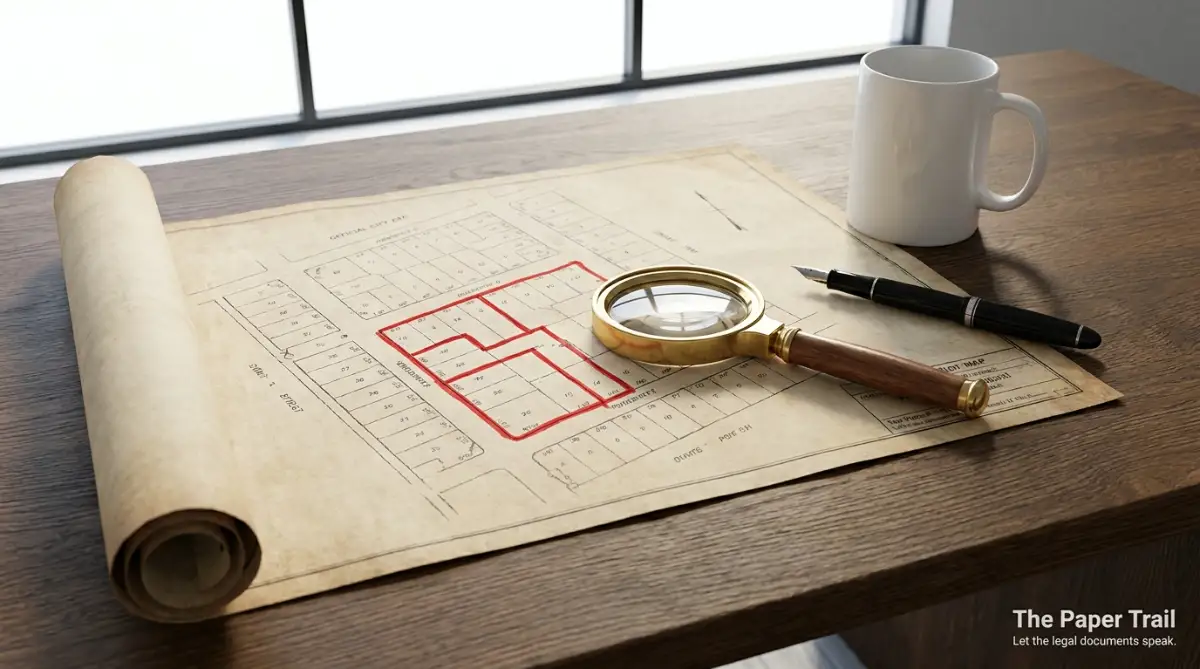
Request a copy of the official plat map for your subdivision from your local municipality. This is a scaled, bird's-eye drawing of how the original developer chopped up the neighborhood into individual numbered parcels.
Lay your deed side-by-side with that plat map. Look for the exact distance measurements of your shared boundary line and compare them to what you are physically seeing out your kitchen window.
Hire a Licensed Professional Surveyor
If the paperwork leaves you scratching your head in confusion, you must hire a professional land surveyor to come out to the property. This is the single most important expense you will incur during this entire ordeal.
An old survey sitting in a folder from the previous owner is helpful, but it will not carry the same weight as a fresh survey with newly set stakes. Over decades, the earth shifts, trees die, roads get widened, and old wooden stakes rot away into the dirt.
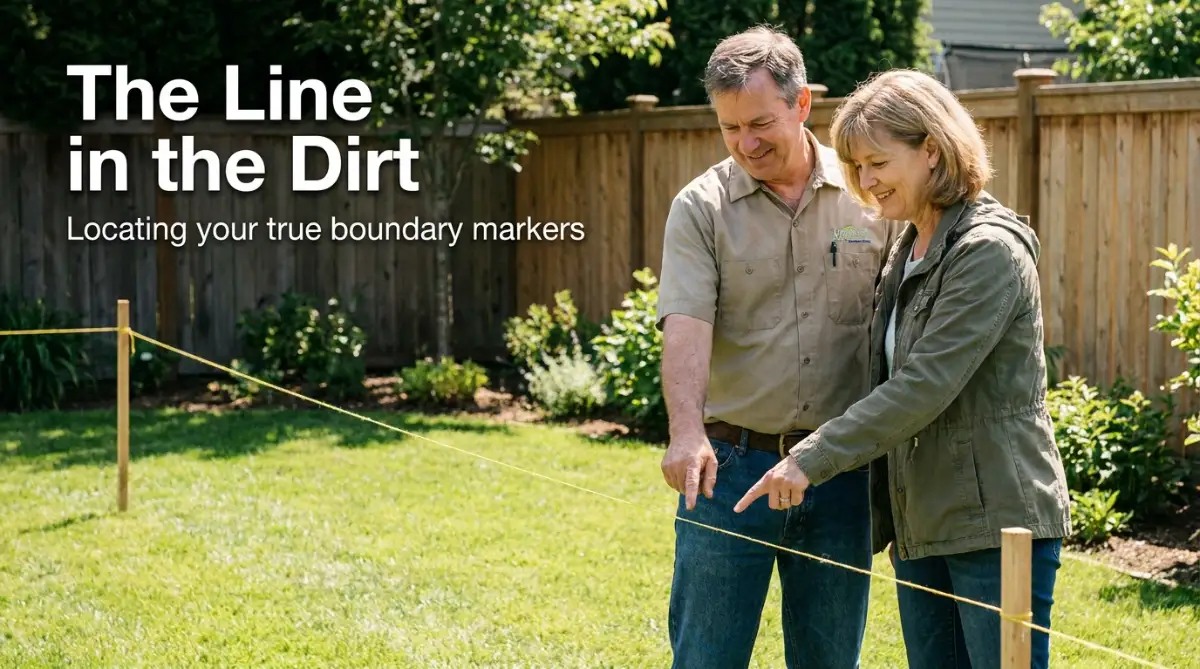
A licensed surveyor will use satellite GPS equipment and historic regional markers to find the exact, indisputable corners of your lot. When they find those corners, they will hammer bright pink or orange wooden stakes directly into the ground.
Those little wooden stakes carry immense psychological weight in a neighborhood dispute. When your neighbor sees an official, state-licensed professional driving iron pins into the ground, their argument suddenly has to fight against math rather than just fighting against you.
Yes, a professional survey can cost anywhere from five hundred to over a thousand dollars depending on the shape of your lot. But that fee is a tiny fraction of what a real estate lawyer will charge you to write a single threatening letter to settle a boundary dispute.
Pro Tip: When I ordered my land survey, I made a huge mistake by not telling my neighbor in advance. They saw a stranger in a bright orange vest measuring their lawn and thought I was launching a surprise legal attack, which made them ten times more defensive; always give them a polite, casual heads-up before the surveyor knocks on the door.
How to Talk to Your Neighbor About a Boundary Encroachment
Once those pink stakes are sitting in the grass, the ball is officially in your court to schedule the conversation. This is the exact moment where ninety percent of homeowners fail because they allow their inner rage to dictate their opening sentence.
Pick a time when neither of you is rushing off to work or trying to unload groceries from the trunk of a car. A bright Saturday morning around ten o'clock is usually the golden hour for neighborhood diplomacy.
Approach them casually in the yard and keep your posture completely relaxed. Do not bring a group of friends with you to stand behind you like a makeshift street gang, because that will trigger an instant defensive reaction.
Use open-ended, non-accusatory sentences to describe the situation. Instead of saying "Your contractor built this fence on my land," try saying "I got a survey done to check the boundary for some future yard projects, and it looks like the true line sits a little bit over here."
Give them an easy psychological escape hatch so they do not feel stupid or targeted. Say something like "I know the previous owners set up these bushes decades ago, so it is super easy to see how everyone got mixed up about where the line sat."
Before you walk across that grass to speak with them, watch this breakdown on how to keep negotiations civil:
This short recording highlights the subtle psychological tricks used by professional mediators to settle high-stress neighbor disputes without a single shout.
Draft a Formal Boundary Line Agreement
If the conversation goes beautifully and your neighbor looks at the pink stakes and says "Oh wow, my bad, I will move my garden bed back over to my side," do not just shake hands and walk away. A handshake feels wonderful in the moment, but a handshake does not bind the person who buys their house five years from now.
You need to take your agreed-upon boundary and put it into a standard, legally recognized Boundary Line Agreement document. This is a simple, two-page legal form that states both parties recognize the surveyed markers as the true, permanent line dividing the properties.
Both of you must sign this document in the presence of a licensed public notary. Once the signatures are stamped, drive down to the county registrar of deeds and pay the small fee to have it attached to both of your property titles forever.
By taking this extra step, you effectively lock down the true perimeter of your home. If your neighbor sells their house next month, the incoming family is legally bound by the document sitting in the county records.
If you skip this step, the new owners can legally claim they bought the house thinking the garden belonged to them, and your exhausting backyard dispute will be reborn from the ashes.
The Reality of Adverse Possession Laws
If your neighbor decides to be incredibly difficult and tells you to shove your new survey down the garbage disposal, you have to educate yourself on a concept known as adverse possession. This is a weird, ancient real estate law that surprises thousands of suburban homeowners every single season.
In simple terms, adverse possession says that if someone uses a piece of your land openly, continuously, and without your permission for a set number of years, they can petition the state to legally take the title of that land away from you.
The exact timeline for this takeover changes wildly depending on the state or province you live in. In some jurisdictions, it takes twenty continuous years of using the land; in others, it can happen in as little as seven years if they have been paying the property taxes on it.
This means that if you sit on your back deck and look at their vegetable garden sitting on your side of the line for twelve years without saying a single word, the court can rule that you surrendered your right to demand its removal.
Your quiet politeness will be used against you in a court of law as a form of silent consent. This is precisely why you can never afford to just let a boundary encroachment slide past you because you want to avoid a brief, uncomfortable ten-minute chat.
When you allow someone to occupy your deeded land without an official, written lease or an explicit written permission slip, you are slowly setting a timer on the ownership of your own real estate. Be incredibly polite to the human beings living next door to you, but be absolutely fiercely protective of the dirt your family relies on.
Mastering the Art of Neighborhood Diplomacy and Legal Strategy
Once you know exactly where your true property line sits, you have to decide how you are going to enforce it. Running straight to a courthouse is almost always a terrible idea for your bank account and your mental health.
The smartest homeowners use advanced, out-of-court strategies to protect their land while keeping neighborhood relations somewhat polite. You want to fix the problem permanently without starting a lifelong feud with the person living twenty feet away from your bedroom.
One of the most effective secrets in real estate law is using a professional third-party mediator instead of an aggressive attack lawyer. A mediator is a trained, neutral professional who sits down with both you and your neighbor in a calm conference room.
They do not take sides, and they do not have the power to force a judge's ruling upon you. Instead, they help both parties communicate clearly to find a middle-ground solution that everyone can tolerate.
According to guidelines from the California Courts system on alternative dispute resolution, mediation is often significantly faster and cheaper than traditional litigation. It allows you to solve the fence issue in a few hours rather than dragging it out over multiple stressful court dates.
If mediation works, the mediator will help you draft a legally binding settlement agreement right there at the table. This completely bypasses the nightmare of a public lawsuit while still giving you hard, written proof of your boundaries.
The "Permission Slip" Strategy to Prevent Legal Loss
Sometimes, your neighbor's driveway might slightly cross onto your dirt, but you really do not want the stress of forcing them to tear up solid concrete. However, you also cannot just sit there in silence, because silent acceptance can eventually lead to them legally taking your land.
This is where a clever legal tool called a "Revocable License" or a formal permission agreement becomes incredibly handy. You are basically giving them a formal, written permission slip to use that tiny sliver of your yard.
By officially granting them permission in writing, you completely destroy any future claims they might make for adverse possession. You are explicitly stating that they do not own the land, they are just borrowing it because you are a generous neighbor.
This simple piece of paper must state that you have the right to revoke this permission at any time. If you ever decide to sell your house, you can instantly cancel the agreement so the new buyer gets a completely clean title.
Building an Unbeatable Paper Trail
If you feel that the situation is slowly turning hostile, you must start documenting every single interaction like a professional investigator. Courts absolutely hate "he said, she said" arguments, because judges cannot read minds to figure out who is telling the truth.
Start keeping a dedicated folder on your kitchen counter just for this boundary issue. Print out your emails, save your text messages, and write down the exact dates and times of any verbal conversations you have across the yard.
If your neighbor starts acting aggressively or making threats about the property line, this documentation will be your absolute best defense. When you finally sit down with an attorney, handing them a highly organized binder saves them hours of research time.
Being prepared is everything when dealing with the legal system. Gathering your emails, surveys, and timeline notes before your first meeting will save you hundreds of dollars in hourly real estate attorney fees.
Investigating Local Zoning and Setback Rules
Here is a brilliant secret that many people completely overlook when fighting over a fence. Sometimes, you do not even need to fight about the exact property line because the city's zoning laws will win the argument for you.
Every local municipality has specific rules called "setback requirements" for residential structures. These rules dictate exactly how far a fence, a shed, or a driveway must be placed away from the official property line.
For example, your local building code might state that all solid privacy fences must be built at least two feet inside the owner's property line. If your neighbor builds a fence directly on the shared boundary line, they are already violating city codes.
You can simply call your local city code enforcement office and ask them to send an inspector out to look at the structure. If the structure violates the local setback rules, the city will force your neighbor to tear it down, and you will not have to spend a single dime on a private lawyer.
What NOT to Do During a Property Line Dispute
When someone violates the boundaries of your home, your initial emotional reaction is usually pure anger. You feel deeply disrespected, and that anger can push you to make incredibly poor, impulsive decisions.
I have seen rational, calm people turn into completely different individuals when a boundary line is threatened. If you let your emotions drive your actions, you can easily turn yourself from the innocent victim into the guilty party.
If you want to keep the upper hand in this dispute, you must maintain your absolute composure. Avoiding these massive legal and emotional traps will protect your reputation and your wallet.
The "Self-Help" Destruction Trap
This is the single most destructive mistake any homeowner can make during a property line argument. Let us say you get a fresh survey, and it proves that your neighbor's new wooden fence is definitely sitting on your grass.
In a fit of rage, you grab a sledgehammer and start violently smashing the fence to pieces because it is technically on your dirt. You might think you are just removing trash from your own lawn, but the police will view it very differently.
Legal experts from the Legal Information Institute at Cornell Law School strongly warn against using "self-help" measures to forcefully reclaim property. Taking matters into your own hands can result in serious criminal charges for vandalism or destruction of private property.
Even if a judge eventually rules that the fence was on your land, they will still make you pay financial damages for destroying your neighbor's building materials. Always let the courts or city officials order the removal of the structure, so your hands remain completely clean.
Relying on Cheap Online Maps
We live in an era where everyone thinks their smartphone has all the answers to complex real estate issues. Many homeowners simply open a popular real estate app or a free satellite map to find their property lines.
They zoom in on the aerial view, see where the digital red line crosses their yard, and assume that is the absolute legal truth. This is a massive, dangerous misunderstanding of how digital mapping actually works.
Those public GIS (Geographic Information System) maps provided by county tax offices are for general tax estimation purposes only. They are notorious for being shifted several feet in the wrong direction due to satellite camera angles.
You cannot walk into a courtroom and show a judge a screenshot from a free internet map to win your case. Only an official drawing stamped by a state-licensed surveyor carries the legal weight necessary to settle a real estate boundary dispute.
Sending Angry Threats in Writing
When you are frustrated, sending a fiery, aggressive text message or an angry handwritten letter might feel incredibly satisfying in the moment. You might think you are just showing them that you are serious and will not be bullied.
However, everything you put into writing becomes a permanent piece of evidence that can be shown to a judge later. If you use threatening language or resort to petty name-calling, you instantly destroy your credibility as a reasonable neighbor.
A judge wants to see that you tried to handle the situation like a mature, cooperative adult. If your neighbor's lawyer can hold up a piece of paper showing you acting aggressively, it completely shifts the sympathy away from you.
Always keep your written communications extremely brief, totally polite, and strictly focused on the facts of the survey. If you cannot write a neutral message, you should absolutely hire a professional to write it for you.
Avoiding the Issue to Keep the Peace
Many homeowners are terrified of confrontation, so they choose the path of least resistance. They notice the neighbor's garden slowly creeping over the line, but they just look the other way and hope the problem magically disappears.
This passive "wait and see" strategy is a ticking time bomb for your property value. As we discussed earlier, ignoring an encroachment can trigger adverse possession laws, literally legally transferring your land to the person stealing it.
Furthermore, unresolved property disputes create a massive headache when you finally decide to sell your house. By law, you must disclose any known boundary disputes to potential buyers on the real estate disclosure forms.
When a young family sees an active boundary war on a disclosure form, they will usually run away from the deal immediately. You must resolve these issues head-on while you still have the energy, ensuring your home remains a clean and sellable asset on the real estate market.
Thinking You Must Sue Immediately
Some people watch too many legal dramas on television and think the only solution is to immediately file a massive lawsuit. They rush out to hire the most aggressive litigator they can find, ready to destroy their neighbor in civil court.
Filing a formal "Quiet Title Action" lawsuit should always be your absolute last resort, never your first step. Lawsuits are shockingly expensive, often dragging on for years and draining thousands of dollars from your savings account.
If you are on a tight budget, launching a full-scale legal war can cause massive financial strain. Because boundary disputes are civil cases, you must fund your own fight, which is why it is essential to explore every out-of-court alternative first.
Give mediation a chance, try talking over the fence, and use city code enforcement before you write a massive retainer check to a private law firm.
Your Action Plan for Reclaiming Your Peace of Mind
Navigating a dispute over where your lawn ends and your neighbor's lawn begins is undeniably exhausting. It tests your patience, strains your wallet, and makes walking outside feel like entering a stressful battleground.
However, you now have a clear, logical roadmap to protect what is rightfully yours without losing your mind in the process. You know that screaming matches achieve nothing, but official land surveys and calm, documented conversations hold immense power.
Your next steps to resolve the issue are simple:
- Find your property deed: Check the legal description and county plat map.
- Hire a licensed land surveyor: Get them to mark the exact boundary corners with stakes.
- Have a calm conversation: Talk to your neighbor with documented proof.
- Draft a Boundary Line Agreement: Sign it with a notary to make it legally binding.
- Use mediation: Try city code enforcement or mediation before considering a lawsuit.
Once you have that undeniable proof in your hands, you can approach the situation with absolute confidence and quiet authority.`
When I finally resolved my own property line nightmare, the relief I felt dropping my shoulders was absolutely incredible. My home finally felt like my personal, safe sanctuary again, and I know you can achieve that exact same peace if you take these smart, calm steps today.
Common Questions About Property Boundaries
Can I legally tear down a fence built on my side of the property line?
No, you should never tear down a fence yourself, even if a survey proves it is clearly on your land. Destroying someone else's building materials can lead to criminal property damage charges against you. Always let a judge or city code enforcement officer order the official removal of the structure.
Who is supposed to pay for the land survey during a neighborhood dispute?
In almost all situations, the person who orders the survey is the one responsible for paying the bill. If you are the one questioning the boundary line, you will need to pay the surveyor out of your own pocket. Sometimes, friendly neighbors will agree to split the cost, but there is no law forcing them to do so.
Does my normal homeowners insurance policy cover boundary disputes?
Generally, standard homeowners insurance policies do not cover the legal costs associated with property line disputes or quiet title lawsuits. The National Association of Insurance Commissioners (NAIC) explains that these policies usually cover sudden physical damage, not preexisting legal boundary issues. You will likely need to pay for any necessary real estate attorney fees out of your own pocket.
Do I really need a lawyer to sign a boundary line agreement?
While it is highly recommended to have a real estate lawyer review the paperwork, you do not strictly need one to sign a simple agreement. As long as the document clearly states the agreed-upon boundary and is signed by both parties in front of a licensed notary, it is valid. You then just need to file it directly with your county recorder's office.
What exactly is the rule of adverse possession?
Adverse possession is a complex real estate law that allows a person to claim legal ownership of someone else's land if they use it openly and continuously without permission. The required time frame varies wildly by state, ranging anywhere from five to twenty continuous years. This is why you must quickly address any boundary encroachments before the legal timer runs out on your property rights.
Disclaimer: The information provided in this blog post is strictly for educational and informational purposes only and does not constitute professional legal advice. Real estate laws vary significantly by state and local municipality. Always consult with a qualified, licensed real estate attorney in your jurisdiction before making any legal decisions regarding your property boundaries or initiating any disputes.